
Garage Door SEO vs Google Ads: Which Is Better?
Every garage door company owner eventually asks the same question: should I put my marketing budget into SEO, into Google […]
A gym owner recently described the exact moment this problem becomes obvious: the front desk logs a steady stream of trial sign-ups every week, the classes look full, the energy is good,…

A gym owner recently described the exact moment this problem becomes obvious: the front desk logs a steady stream of trial sign-ups every week, the classes look full, the energy is good, and yet at the end of the month, membership numbers barely moved. The leads were never the problem. Something between “showed interest” and “became a paying member” is quietly leaking, and most gyms never diagnose exactly where.
This article is built to fix that diagnosis problem first, then walk through the specific repairs for each stage of the funnel, because the honest answer to “why aren’t my trials converting” is almost never one single cause. It’s usually one particular stage, hiding in plain sight, that’s costing you more members than everything else combined.
Before touching scripts, offers, or follow-up sequences, there’s one diagnostic step almost every gym skips, and it changes everything about where you should focus first: separate your show-up rate from your conversion rate.
Most gym owners lump these together into one vague number, “our trial conversion is bad”, but they are two entirely different problems with two entirely different fixes.
Show-up rate measures how many people who booked a trial actually walked through the door. Conversion rate measures, of the people who actually showed up and experienced your gym, how many became paying members.
Here’s why this split matters so much: if your show-up rate is weak, the problem lives in your booking confirmation, reminders, and pre-trial communication, not in your sales conversation, your coaches, or your pricing. Fixing your closing script won’t help a single bit if half your trials never show up in the first place. Conversely, if people are showing up consistently but not converting, the problem lives in the actual in-gym experience and the sales conversation at the end of it, and no amount of reminder texts will fix that.
Pull your numbers apart before doing anything else:
Once you can see these four numbers separately, the leak becomes obvious, and you stop wasting time fixing a stage that was never actually broken.

If your show-up rate is the weak link, here’s what actually moves it.
Research on sales lead response time, published in Harvard Business Review, studied over 100,000 web leads across more than 2,000 companies and found that responding within five minutes made a sales team roughly 100 times more likely to actually connect with the lead compared to waiting just thirty minutes. A trial booking is essentially a high-intent lead with a specific date attached, and the same principle applies directly: if a booking confirmation and a personal follow-up don’t happen almost immediately, interest cools fast.
A single confirmation email or text isn’t enough on its own. A structured touchpoint sequence, an immediate confirmation, a reminder the day before, and a same-day “see you soon” message, keeps the trial top of mind through everyday life distractions that otherwise cause no-shows.
There’s real data showing that trial duration affects how many people ultimately convert. Trials running somewhere in the range of roughly two to four weeks have shown meaningfully higher conversion outcomes than very short, four-day trials. A longer window gives someone the chance to build an actual habit and see real change, rather than making a decision off a single, possibly awkward, first visit.
Send exactly what to bring, what to wear, and where to park in the confirmation message itself. Removing small logistical uncertainties reduces the quiet, easy-to-rationalize reasons someone talks themselves out of showing up.
Assuming people are showing up, the next question is whether the actual experience is building toward a sale, or just happening to them passively.
A trial with no single person responsible for it tends to fall through the cracks. Whoever books the trial should also be the one checking in during it and having the eventual membership conversation, a disconnected hand-off between whoever generated the lead and whoever runs the class is one of the most common, quietly damaging gaps in the whole process.
People convert when they can feel or see change, not simply when they’ve shown up a certain number of times. Basic markers, a note about how a first squat looked compared to session three, a quick check-in about energy or sleep, a small acknowledged win, give a trial member concrete evidence that something is actually working, which becomes the foundation of the closing conversation later.
Reaching out only once, right at the very end of the trial, misses the opportunity to build a relationship along the way. A short mid-trial check-in, “how’s it feeling so far, anything I can help adjust?”, keeps the prospect engaged and gives you real information to draw on during the eventual sales conversation.
This is the stage most gyms either skip outright or handle so awkwardly that a genuinely good trial experience still fails to convert. The biggest mistake here is trying to sell casually on the gym floor instead of having a dedicated, structured conversation.
Have this conversation at the final session of the trial, or the day before it ends, not weeks afterward, once the emotional momentum has faded, and not on day one, before there’s anything real to point back to.
The most effective version of this conversation follows a simple arc: ask genuinely how the trial went and let them answer fully without interrupting, connect what they’ve told you back to the goal they originally came in with, and then present continuing as the natural, obvious next step rather than a hard sell.
A soft close sounds something like this: “So here’s where you’re at, you came in wanting [their stated goal], you’ve made it through the sessions, and by the sound of it you’re already noticing [the specific thing they mentioned]. The natural next step is just to keep going. Does that feel right to you?” Then stop talking. Let them answer. Filling that silence yourself is one of the easiest ways to undercut an otherwise strong close.
Show the lower-commitment option first (typically month-to-month), followed by the better-value option (typically an annual plan), and let the person choose based on where they genuinely are rather than being steered toward whichever option benefits your revenue most in the moment. This isn’t just more ethical, it also reads as more trustworthy, which itself improves close rates.
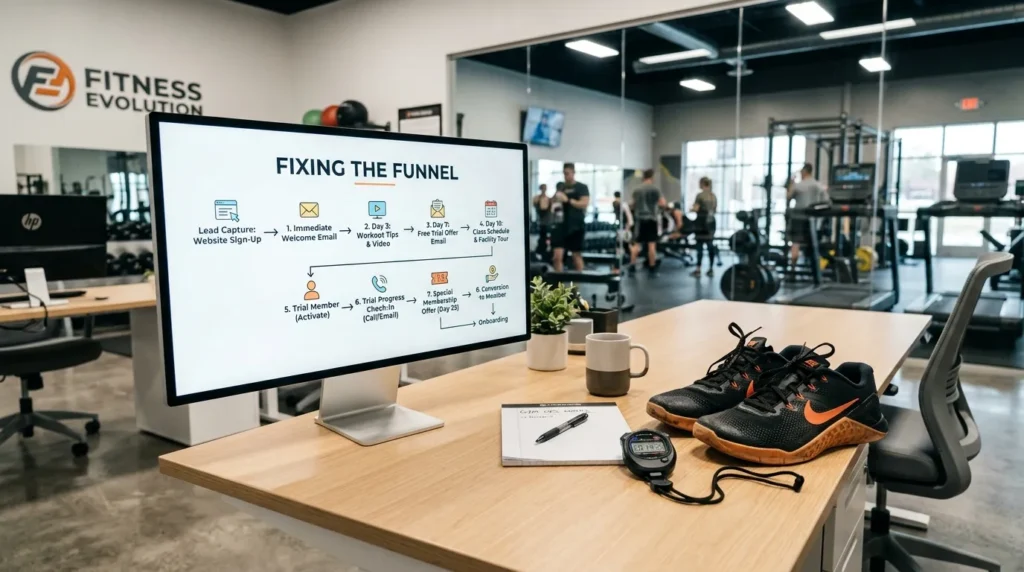
Here’s where a lot of standard funnel advice stops too early. The moment someone signs a membership isn’t the finish line, it’s the start of the stage that determines whether that sale actually turns into lasting revenue. A strong onboarding sequence typically includes a welcome touchpoint immediately after signing, a clear first-class checklist so the transition from trial member to full member feels seamless, a check-in around the one-week mark, a goal review around thirty days in, and some kind of recognition at the ninety-day milestone.
This matters because retention is what makes your entire acquisition effort worthwhile in the first place. A gym that converts trials well but loses new members within the first couple of months is essentially refilling a leaking bucket, and every dollar spent generating the original lead gets wasted the moment that member quietly cancels.
Rather than obsessing over generic industry benchmarks that vary wildly depending on how they were measured, track your own five numbers consistently, every week, so you can see your own trend over time:
Reported industry figures for trial-to-paid conversion vary enormously depending on what’s actually being measured and what channel the lead came from, a cold digital ad lead converting at a modest single-digit rate is a genuinely different situation than a warm referral converting at the same rate, even though the raw number looks identical. Your own number, tracked consistently and watched for improvement over time, is far more useful than chasing an industry average that may not reflect your specific traffic sources at all.
If you looked at last month’s funnel numbers right now, could you say with confidence which single stage is leaking the most members, the booking-to-show-up gap, the in-trial experience, the membership conversation itself, or early-stage retention after signing? Most gym owners can’t answer that question in the moment, and that gap in visibility is usually where the next real stretch of growth is quietly sitting, waiting to be fixed.
Fixing a gym’s sales funnel isn’t about finding one clever script or one better discount. It’s about separating show-up rate from conversion rate so you know which problem you’re actually solving, giving the trial experience real structure and visible progress instead of letting it happen passively, having a genuine, unhurried membership conversation at the right moment, and treating onboarding as the final stage of the funnel rather than an afterthought once the sale is done. Track your own five numbers consistently, fix the single worst leak first, and let the rest of the system follow.
Keep reading
 Blog
Blog Every garage door company owner eventually asks the same question: should I put my marketing budget into SEO, into Google […]
 Blog
Blog A lot of garage door companies build a website with a homepage, a services page, and a contact page — […]
 Blog
Blog SEO takes months to pay off. Google Ads can start ringing your phone today. For garage door companies, where a […]
Marketing
Reviews, local SEO and a website that is easy to use work best together. Tell us about the business and we’ll tell you, plainly, what we would do next.