
Garage Door SEO vs Google Ads: Which Is Better?
Every garage door company owner eventually asks the same question: should I put my marketing budget into SEO, into Google […]
SEO takes months to pay off. Google Ads can start ringing your phone today. For garage door companies, where a huge share of demand is urgent (“my spring just snapped,” “door won’t…
SEO takes months to pay off. Google Ads can start ringing your phone today. For garage door companies, where a huge share of demand is urgent (“my spring just snapped,” “door won’t open and my car is trapped”), paid search is often the fastest way to capture customers who are ready to call right now. Here’s a complete, start-to-finish guide to running Google Ads that actually generate calls instead of just burning budget.
Garage door searches are high-intent by nature. Almost nobody searches “garage door repair near me” for fun — they search it because something is broken and they need it fixed soon. That combination of urgency and local intent is exactly what Google Ads is built to capture, especially through call-focused campaigns and the Local Services Ads platform.
Unlike SEO, which competes for organic rankings over time, Google Ads lets you buy your way to the top of the results page immediately, as long as your campaign is set up correctly. The catch is that garage door keywords can be expensive, so structure and targeting matter enormously.
Not all Google Ads campaigns work the same way for this industry. The two most important options are:
Local Services Ads (LSA): These appear above traditional search ads, show your reviews and a “Google Guaranteed” badge, and you pay per lead rather than per click. For emergency home services like garage door repair, LSAs often produce the lowest cost per booked job because you’re only charged when someone actually calls or messages you.
Search Ads (traditional PPC): These give you more control over keywords, ad copy, and landing pages. They’re essential for capturing broader intent — installation quotes, opener upgrades, commercial garage door services that LSAs don’t always cover as well.
Most successful garage door advertisers run both together: LSAs for immediate repair emergencies, and Search campaigns for everything else.
A common mistake is lumping every service into one campaign with one generic ad. Instead, separate campaigns (or at minimum, tightly themed ad groups) by intent:
Each group should have its own tightly matched keywords, ad copy, and landing page. Emergency searchers want to see speed and availability (“Same-Day Service,” “Available Now”). Installation searchers want to see pricing transparency and options. Mixing these messages in one ad group dilutes your relevance score and your conversion rate.
Garage door ad copy performs best when it speaks directly to the situation someone is in. A few principles:
Sending paid traffic to your homepage is one of the most common ways garage door companies waste ad spend. Each campaign should point to a dedicated landing page that matches the ad’s promise.
A strong landing page for paid traffic includes:
Faster load times also directly affect your Quality Score, which lowers your cost per click over time.
Garage door keywords attract a lot of irrelevant traffic if you’re not careful DIY searchers, part manufacturers, job seekers, and people looking for garage organization or storage rather than repair. Build a negative keyword list early and update it regularly based on your search terms report. Common exclusions include terms like “jobs,” “how to fix,” “diy,” “parts wholesale,” and “garage storage.”
This single habit reviewing search terms weekly and adding negatives often has a bigger impact on cost per lead than almost any other optimization.
Garage door keywords, especially “garage door repair near me” and similar high-intent phrases, are competitive and can carry a meaningful cost per click in most markets. Before launching:
For a call-driven business, clicks and impressions are vanity metrics. What matters is:
Without this, you’re optimizing blind. With it, you can identify which keywords and ads are actually producing paying customers — and shift budget accordingly.

Your Local Services Ads eligibility and Quality Score are both influenced by your reputation. A steady stream of recent, positive reviews improves ad performance, lowers costs over time, and increases the likelihood someone clicks your ad over a competitor’s. Make review requests part of your standard job-completion process, not an afterthought.
Running Google Ads well requires ongoing attention, keyword refinement, negative keyword updates, bid adjustments, and landing page testing. Some garage door owners manage this themselves successfully, especially in smaller markets with less competition. In more competitive metro areas, many companies bring in a specialist or agency familiar with home service advertising, since the cost of mismanaged campaigns (wasted clicks, poor Quality Scores) often exceeds the cost of hiring help.
Whichever path you choose, the fundamentals stay the same: intent-based structure, urgency-driven messaging, fast landing pages, aggressive negative keyword management, and call tracking tied to real bookings.
Google Ads can be one of the fastest ways for a garage door company to generate calls, but only when it’s built around how people actually search during a garage door emergency or purchase decision. Structure campaigns by intent, write copy that matches urgency, send traffic to landing pages built to convert, and track calls all the way to booked jobs. Do that consistently, and paid search becomes a predictable source of new business rather than an expensive guessing game.
Keep reading
 Blog
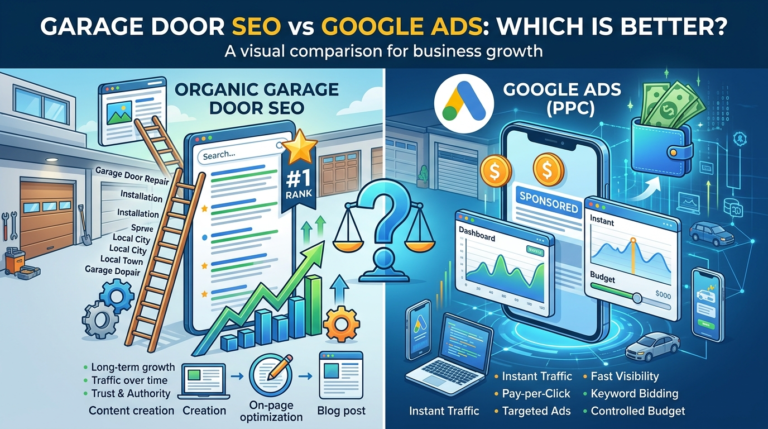
Blog Every garage door company owner eventually asks the same question: should I put my marketing budget into SEO, into Google […]
 Blog
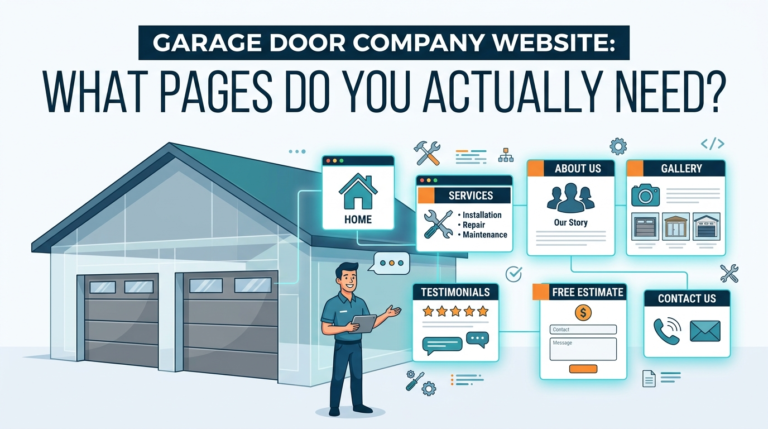
Blog A lot of garage door companies build a website with a homepage, a services page, and a contact page — […]
 Blog
Blog If your garage door company isn’t showing up when someone searches “garage door repair near me,” you’re handing free jobs […]
Marketing
Reviews, local SEO and a website that is easy to use work best together. Tell us about the business and we’ll tell you, plainly, what we would do next.