
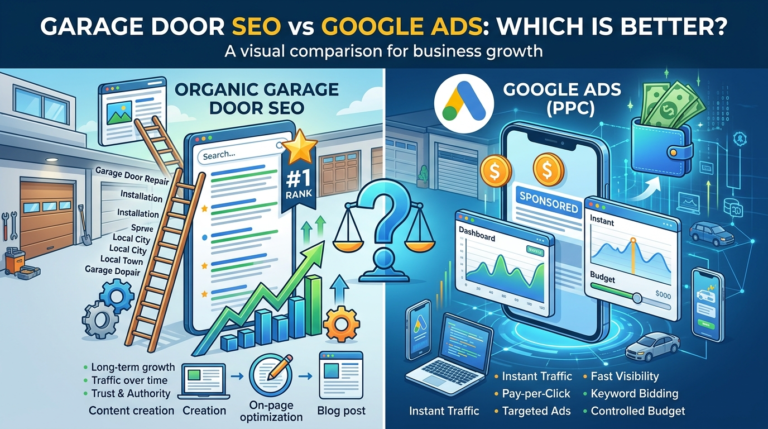
Garage Door SEO vs Google Ads: Which Is Better?
Every garage door company owner eventually asks the same question: should I put my marketing budget into SEO, into Google […]
Nearly every gym owner has heard the same advice by now: post consistently, mix up your content types, and use a scheduling tool. That advice isn’t wrong, but it’s also not enough…
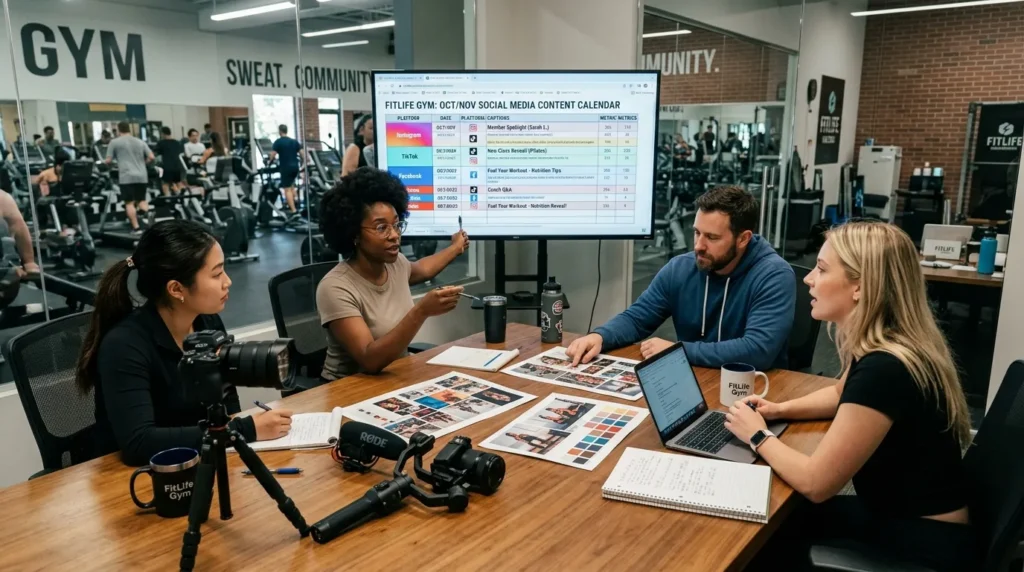
Nearly every gym owner has heard the same advice by now: post consistently, mix up your content types, and use a scheduling tool. That advice isn’t wrong, but it’s also not enough to actually build a calendar that runs itself month after month without you scrambling every Sunday night trying to figure out what to post on Monday. Most guides on this topic stop at “plan three months ahead and use Hootsuite,” without ever showing what actually goes into those three months or how to keep it running once the initial excitement of setting it up wears off.
This article goes further. Below you’ll find a complete system: the content categories that actually matter for a gym specifically (not a generic business), a real weekly framework you can copy, a full 12-month seasonal theme map built around how gym demand actually shifts throughout the year, a practical workflow for collecting content without doing it all yourself, and the tracking system that tells you whether your calendar is actually working or just keeping you busy.
Before building the system, it’s worth understanding why so many well-intentioned content calendars quietly die out. It’s rarely a lack of ideas, it’s almost always one of three things: the calendar depends entirely on one person who eventually gets too busy, the content isn’t actually tied to a business goal so there’s no way to tell if it’s working, or the plan was built too far in advance with no flexibility, so a single busy week throws the whole thing off permanently.
A calendar that lasts is built around a repeatable system, not a one-time three-month plan. That distinction shapes everything below.
Content pillars are the recurring categories your posts rotate through. Most generic advice suggests vague pillars like “educational” and “promotional.” For a gym, it works much better to get specific, because each pillar should map to a different job in your marketing funnel.
Community & Culture — real class moments, member interactions, group energy. This is what makes a prospect feel like they’re missing out on something, and it’s what makes current members feel like they belong. Job: attract new prospects and retain current members emotionally.
Coach Credibility — trainer expertise, coaching tips, myths debunked, program design insight. This builds trust in your staff before someone ever steps inside. Job: move a prospect from aware to interested.
Real Results — member transformations, PRs, milestones, in their own words wherever possible. Job, provide social proof that moves someone from interested to ready to try.
Practical Information — pricing transparency, class schedules, what to expect on day one, parking, childcare, FAQs. This is the pillar almost every competitor guide skips, and it’s often what quietly kills conversions when it’s missing. Job: remove the logistical friction standing between interest and booking.
Offers & Direct CTAs — trial promotions, challenge sign-ups, referral incentives, seasonal campaigns. Job: convert warm interest into an actual booked trial or sign-up.
Behind the Scenes & Brand Personality — the personality of your gym beyond the workouts, staff humor, day-to-day operations. Job: build familiarity and differentiate you from every other gym posting identical stock-style content.
A useful ratio to aim for is roughly 60% community, coaching, and results content, 20% practical information, and 20% direct offers. This keeps your feed from feeling like a constant sales pitch while still making sure conversion-focused content shows up regularly enough to actually drive bookings.
Rather than planning every single post from scratch each week, assign each day of the week a loose theme. This gives you structure without rigidity, and it makes brainstorming dramatically faster because you’re never starting from a completely blank page.
Monday — Motivation & Momentum: Kick off the week with high-energy content, a Monday class highlight, or a weekly challenge announcement.
Tuesday — Coach Spotlight or Educational Tip: A trainer-led tip, form correction, or piece of coaching philosophy.
Wednesday — Community & Culture: Member spotlights, group class energy, behind-the-scenes moments.
Thursday — Results & Social Proof: Transformation stories, PR celebrations, milestone shoutouts.
Friday — Practical Info or FAQ: Answer a real logistical question, share weekend class schedule, address a common hesitation.
Saturday — Offer or CTA-Focused Post: Promote your current trial offer, challenge, or referral program.
Sunday — Light/Personality Content: Something lower-effort and more personal, a meme, a staff moment, a light Q&A — to keep the week from feeling entirely promotional.
This isn’t a rigid rule you need to follow every single week without deviation — it’s a default structure to fall back on so you’re never staring at a blank calendar wondering what today’s post should be.
This is the piece almost every generic content calendar guide skips entirely, and it’s arguably the most valuable part of planning for a gym specifically, because gym demand is genuinely seasonal in a way most other local businesses aren’t.
January — New Year Momentum: This is your highest-intent month of the year. Lean heavily into beginner-friendly content, judgment-free messaging, and structured challenge programs. Content should specifically target people who haven’t set foot in a gym in years, not your already-fit existing members.
February — Habit Reinforcement: January’s resolution crowd starts dropping off around now. Shift content toward encouragement, small-win celebrations, and community reinforcement to help new members stick through the point where motivation naturally dips.
March — Spring Momentum Building: Start building toward summer-focused content without going all-in yet. Good month for challenge programs with a defined end date tied to early summer.
April–May — Summer Prep Ramp-Up: This is typically your second-biggest demand window of the year. Body-focused challenge content, structured programs with a countdown, and increased offer-focused posting all perform well here.
June — Peak Summer Push: Continue strong offer and results-focused content, but also start incorporating outdoor and travel-friendly workout content, since many members’ routines shift seasonally.
July–August — Retention Focus: Historically a slower acquisition period due to vacations and summer schedules. Shift weighting toward retention and community content to keep current members engaged rather than pushing hard on new-member offers that will underperform against summer distractions.
September — Back-to-Routine Momentum: A genuine secondary surge month as schedules normalize after summer. Treat this almost like a mini New Year’s push, with renewed beginner-friendly and habit-building content.
October — Community & Culture Emphasis: A good month for events, challenges tied to fall themes, and deeper community-building content as the immediate post-summer surge levels off.
November — Gratitude & Retention: Member appreciation content, thankfulness-themed community posts, and early messaging that plants the seed for January without fully launching into resolution-season content yet.
December — Light Content & Early Momentum Building: Many gyms see reduced engagement during the holiday stretch. Keep posting consistent but lighter content, and begin teasing your January challenge or promotion in the back half of the month to build anticipation before the resolution surge hits.
Overlaying this seasonal map onto your weekly framework from Step Two gives you a full calendar structure that adjusts throughout the year rather than repeating the same rotation regardless of season, which is one of the most common reasons gym content starts to feel stale by mid-year.

Most content calendar advice assumes someone is sitting down to create every post from scratch each week. In practice, the gyms that stay consistent long-term build a system for collecting raw content continuously, rather than creating everything reactively.
Assign content capture to your trainers, not just your marketing person. Ask each coach to grab 30 seconds of footage from one class a week — the highest energy rep, a member celebrating a milestone, whatever stands out. This spreads the workload and results in more authentic, varied footage than one person trying to capture everything alone.
Create a shared, always-open folder or channel where staff can drop raw clips and photos as they happen, rather than trying to remember them at the end of the week. A simple shared phone album or a dedicated messaging channel works fine — the tool matters far less than having somewhere content actually gets deposited consistently.
Batch-film dedicated content once every week or two, separate from spontaneous class footage. Set aside 60–90 minutes to film coach tips, FAQ answers, and any planned announcement content in one sitting, using similar lighting and setup so editing is fast and consistent.
Build a standing request for member testimonials into your existing member touchpoints — ask for a quick video reaction right after someone hits a personal milestone, rather than reaching out cold weeks later when the moment has passed and the response feels forced.
This workflow matters because a content calendar with perfectly planned themes still fails if there’s no reliable source of raw material feeding into it week after week.
A one-person gym marketing operation and a multi-location team with a dedicated social media coordinator need genuinely different tooling, and using an overly complex system when you don’t need one is often what causes people to abandon their calendar altogether.
Solo owner or single trainer: A simple shared spreadsheet or a free planning tool is genuinely enough. The goal at this size is just having somewhere to jot down what’s coming up, not a complex project management system.
Small team (2–5 people involved in content): A visual scheduling and planning tool that supports basic collaboration and a content calendar view helps coordinate who’s creating what without constant back-and-forth messaging.
Multi-location or larger marketing team: A dedicated social media management platform that supports approval workflows, bulk scheduling across locations, and centralized analytics becomes worth the added cost and complexity at this scale, since coordination overhead grows quickly with more contributors and more locations.
Regardless of scale, the tool should reduce friction, not add a new layer of admin work that becomes its own reason to fall behind.
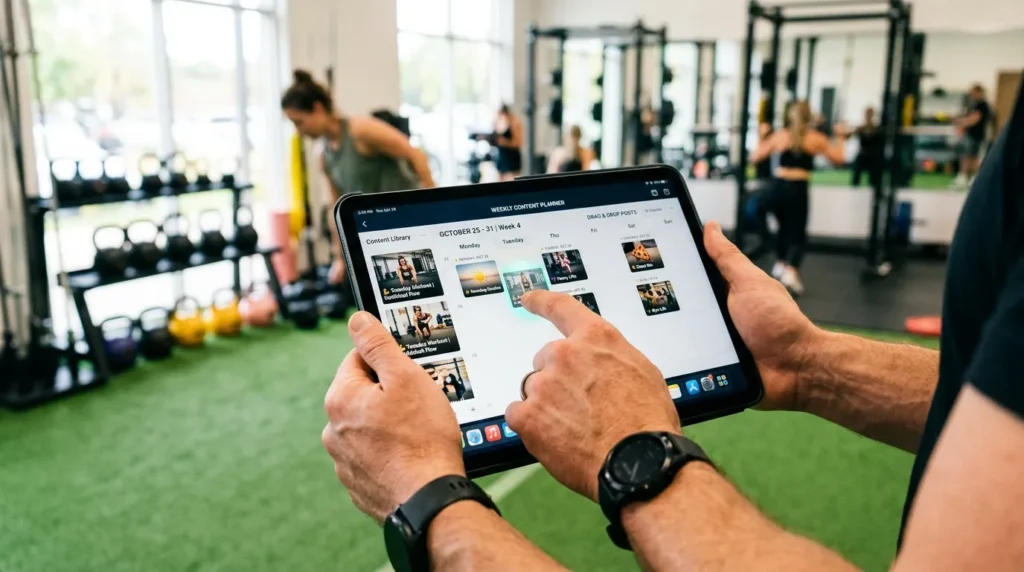
Almost every generic content calendar guide stops at “check your analytics,” without specifying which numbers actually matter for a gym’s business goals versus which ones just feel good to look at.
Vanity metrics worth glancing at but not obsessing over: follower count, likes, raw view count. These indicate reach but say nothing about whether content is actually moving people toward membership.
Metrics that actually connect to business outcomes:
Review these numbers monthly, not daily. Social media performance naturally fluctuates week to week, and reacting to short-term dips often leads to abandoning content types that were actually working over a longer time horizon.
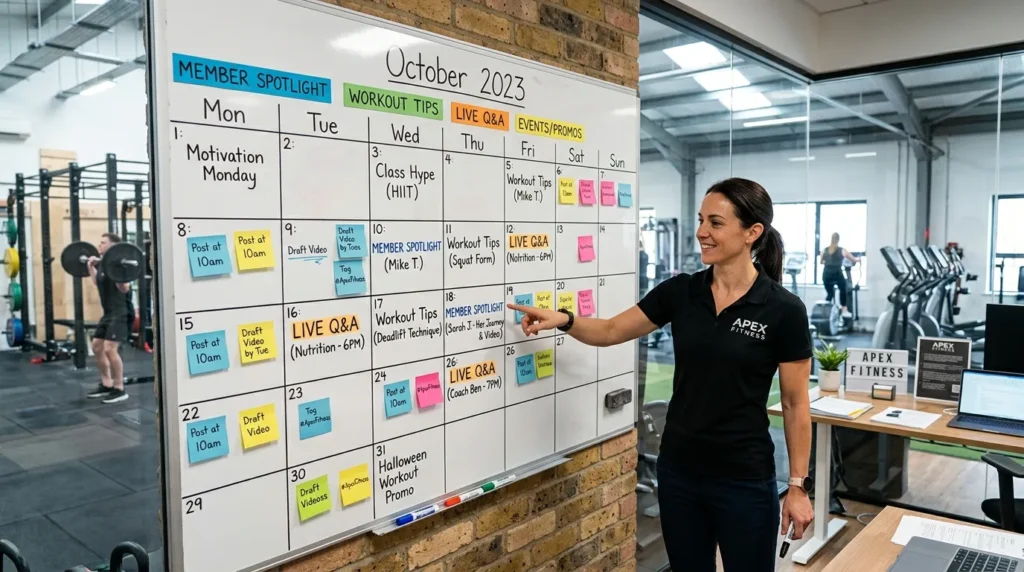
Planning too far ahead without flexibility. A calendar mapped out six months in advance sounds thorough, but it often becomes a straightjacket that ignores real-time trends, local events, or a piece of content that’s suddenly performing exceptionally well and deserves a follow-up. Plan the season-level themes far ahead, but keep weekly execution flexible.
Treating the calendar as “set it and forget it.” Scheduling posts in advance is not the same as engaging with your audience. A calendar that runs on autopilot without anyone replying to comments or DMs loses much of its relationship-building value.
Overloading on promotional content because it feels more directly tied to results. Audiences tune out feeds that read as a constant sales pitch. The community, coaching, and results content is what earns the attention that your offers then convert.
No one person owning the calendar’s upkeep. Even in a collaborative system, someone needs to be responsible for making sure the calendar actually gets filled and adjusted weekly, or it quietly reverts to reactive, last-minute posting within a month or two.
Ignoring what’s already working. Many gyms rebuild their content plan from scratch every quarter instead of reviewing what performed well previously and deliberately doing more of it. Revisit your top-performing posts from the last 60–90 days before planning the next stretch, rather than starting with a blank slate every time.
A content calendar that actually works for a gym isn’t a static three-month spreadsheet, it’s a repeatable system built around gym-specific content pillars, a weekly rhythm that removes decision fatigue, a seasonal map that matches how gym demand genuinely shifts throughout the year, and a real workflow for continuously collecting raw content instead of creating everything from scratch each week. Build the system once, track the metrics that actually connect to memberships rather than vanity numbers, and revisit it quarterly based on what’s genuinely working rather than restarting from zero every time.
Keep reading
 Blog
Blog Every garage door company owner eventually asks the same question: should I put my marketing budget into SEO, into Google […]
 Blog
Blog A lot of garage door companies build a website with a homepage, a services page, and a contact page — […]
 Blog
Blog SEO takes months to pay off. Google Ads can start ringing your phone today. For garage door companies, where a […]
Marketing
Reviews, local SEO and a website that is easy to use work best together. Tell us about the business and we’ll tell you, plainly, what we would do next.