
Garage Door SEO vs Google Ads: Which Is Better?
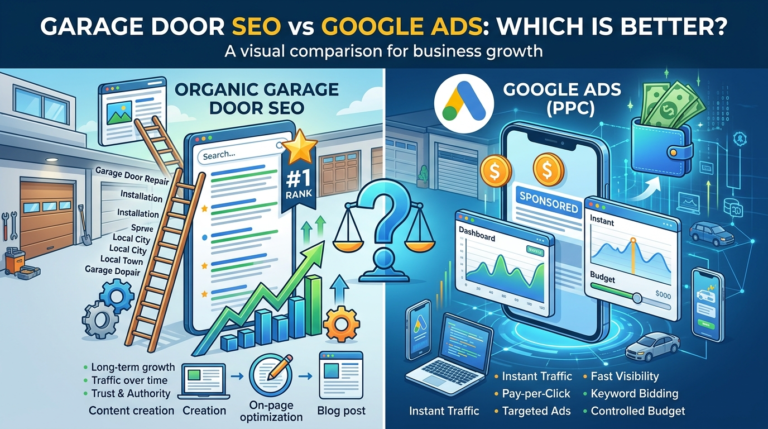
Every garage door company owner eventually asks the same question: should I put my marketing budget into SEO, into Google […]
This is usually one of the first questions an orthodontist asks once they decide to take marketing seriously, and it’s also one of the hardest to answer with a single number. A…

This is usually one of the first questions an orthodontist asks once they decide to take marketing seriously, and it’s also one of the hardest to answer with a single number. A solo practice in a small town and a five-location group in a competitive metro area shouldn’t be spending the same amount, and treating marketing as a fixed line item rather than an investment tends to produce disappointing results either way.
That said, there are real benchmarks worth knowing, and a clear way to think through what fits your specific practice. Here’s the full breakdown.
Most established orthodontic practices invest somewhere between $2,500 and $10,000 per month on digital marketing, depending on practice size, market competitiveness, and how many channels are active at once. Newer practices or single-location offices in smaller markets typically sit toward the lower end. Multi-location practices or those in highly competitive metro areas often need the higher end of that range, or beyond it, to stay visible against well-funded competitors.
A simpler way many practice owners think about it: 5% to 10% of gross revenue reinvested into marketing is a common range across healthcare and dental specialties, with practices in growth mode often pushing closer to 10-12%, and well-established practices with strong referral networks sometimes spending less.
Neither number is a strict rule. They’re a starting point for a conversation, not a formula that fits every practice exactly.
A marketing budget rarely goes to just one thing. A complete strategy typically spans several channels, each with a different role and cost structure.
SEO is usually billed as a flat monthly retainer, commonly ranging from $1,000 to $4,000 per month, depending on the competitiveness of the local market and the scope of work — content creation, technical fixes, local citation building, and ongoing optimization all factor into the cost. SEO is a longer-term investment, results build over months, not days, but it continues generating traffic without an ongoing per-click cost once it’s established.
Paid search budgets vary widely based on market competition. Many orthodontic practices spend $1,500 to $5,000 per month on ad spend alone, separate from any management fee charged by an agency. Competitive metro markets can push cost-per-click for terms like “Invisalign near me” considerably higher than smaller towns, which directly affects how far a given budget stretches.
A professionally designed, conversion-focused website is typically a one-time investment, often ranging from $3,000 to $15,000 depending on complexity, with ongoing hosting and maintenance costs of roughly $50 to $300 per month afterward. This isn’t usually a recurring marketing expense, but it’s worth budgeting for separately since an outdated or slow website undermines the return on every other channel.
Blog posts, service pages, and educational content are often priced per piece or bundled into a broader retainer, generally ranging from $150 to $500 per blog post depending on length and research depth. Practices publishing 2-4 posts per month should expect this to be a meaningful, ongoing line item.
Managing social platforms consistently, posting, engaging, and creating content like before-and-after reels or patient testimonials, typically runs $500 to $2,500 per month, depending on posting frequency and whether paid social promotion is included.
Some practices fold this into a broader retainer, while others budget separately for it, generally in the range of $200 to $800 per month for tools and processes that prompt, monitor, and respond to patient reviews consistently.

A practice in a major metro area with a dozen competing orthodontists nearby needs a meaningfully larger budget than a practice in a smaller town with limited competition. Competitive cost-per-click pricing alone can make the same campaign cost two or three times as much depending on the market.
Each additional location generally requires its own local SEO investment, its own Google Business Profile management, and often its own city-specific landing pages and ad campaigns. Budgets should scale accordingly rather than spreading one location’s budget thin across several.
A newer practice still building its patient base typically needs to invest more aggressively in the short term to establish visibility, while an established practice with a strong referral network and reputation may be able to maintain growth with a comparatively smaller, more efficient budget.
A practice starting from an outdated website with no SEO foundation usually needs a larger initial investment to catch up, while a practice with an already solid foundation can often allocate more of its budget toward ongoing growth rather than fixing structural issues first.

Spending the “right” amount doesn’t guarantee results if the money isn’t allocated well. A few common ways budgets get wasted:
For practices unsure where to start, a reasonable approach looks like this:
This isn’t a rigid formula, but it gives new practices a defensible starting point rather than guessing, and it can be adjusted as data comes in on what’s actually converting.
Two practices can spend the exact same monthly budget and get very different results, depending on how well that budget is targeted, how strong the website converting that traffic is, and how consistently the strategy is maintained over time. A smaller, well-managed budget focused on the right channels will consistently outperform a larger budget spread thin across everything at once.
The most useful exercise isn’t picking a number off a benchmark chart, it’s understanding your current cost per booked consultation, your patient lifetime value, and how much room that leaves for sustainable, profitable marketing investment.
If you’d like help figuring out what a realistic, effective budget looks like for your specific practice and market,schedule a free consultation to walk through your numbers together.
There is no one-size-fits-all budget, but many orthodontic practices invest a percentage of their annual revenue into marketing. The right amount depends on your goals, local competition, and whether you’re focused on growth, maintaining patient volume, or expanding into new markets.
Several factors can influence your budget, including the size of your practice, the number of locations you operate, the competitiveness of your area, and the marketing channels you use. A practice in a highly competitive city may need a larger investment than one in a smaller market.
In many cases, yes. New practices often need to build awareness and establish a patient base from the ground up. Investing more heavily during the early stages can help generate visibility, attract consultations, and create momentum for long-term growth.
Many successful practices prioritize local SEO, website improvements, online reviews, paid advertising, and educational content. These efforts can help increase visibility, strengthen credibility, and connect with people actively searching for orthodontic treatment.
The best way is to track meaningful results rather than focusing only on website traffic or social media engagement. Metrics such as consultation requests, phone calls, appointment bookings, and new patient numbers provide a clearer picture of marketing performance.
Keep reading
 Blog
Blog Every garage door company owner eventually asks the same question: should I put my marketing budget into SEO, into Google […]
 Blog
Blog A lot of garage door companies build a website with a homepage, a services page, and a contact page — […]
 Blog
Blog SEO takes months to pay off. Google Ads can start ringing your phone today. For garage door companies, where a […]
Marketing
Reviews, local SEO and a website that is easy to use work best together. Tell us about the business and we’ll tell you, plainly, what we would do next.