
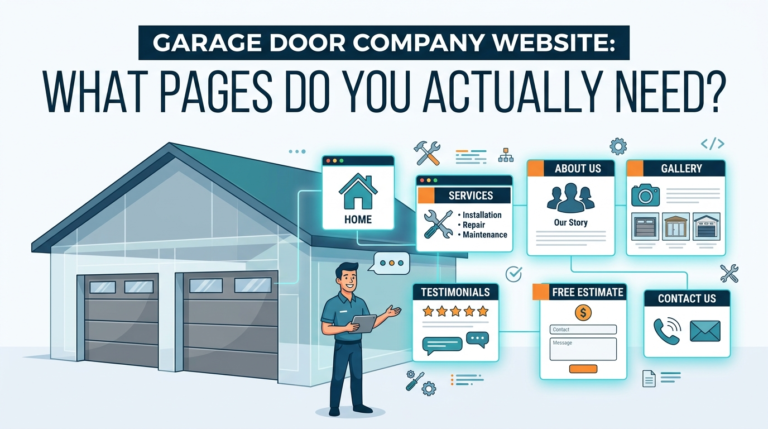
Garage Door Company Website: What Pages Do You Actually Need?
A lot of garage door companies build a website with a homepage, a services page, and a contact page — […]
Every garage door company owner eventually asks the same question: should I put my marketing budget into SEO, into Google Ads, or both? It’s a fair question, because both channels put you…
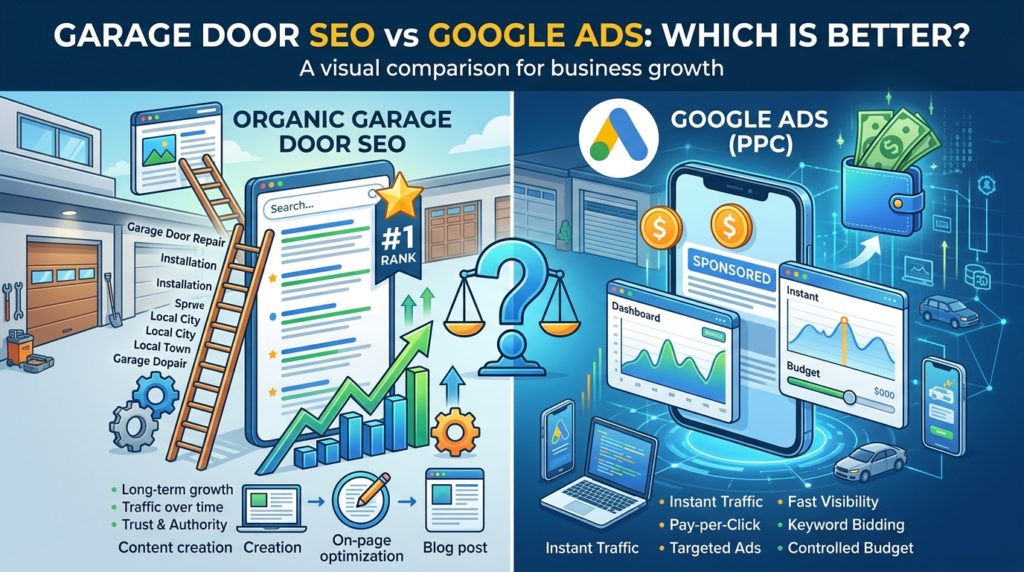
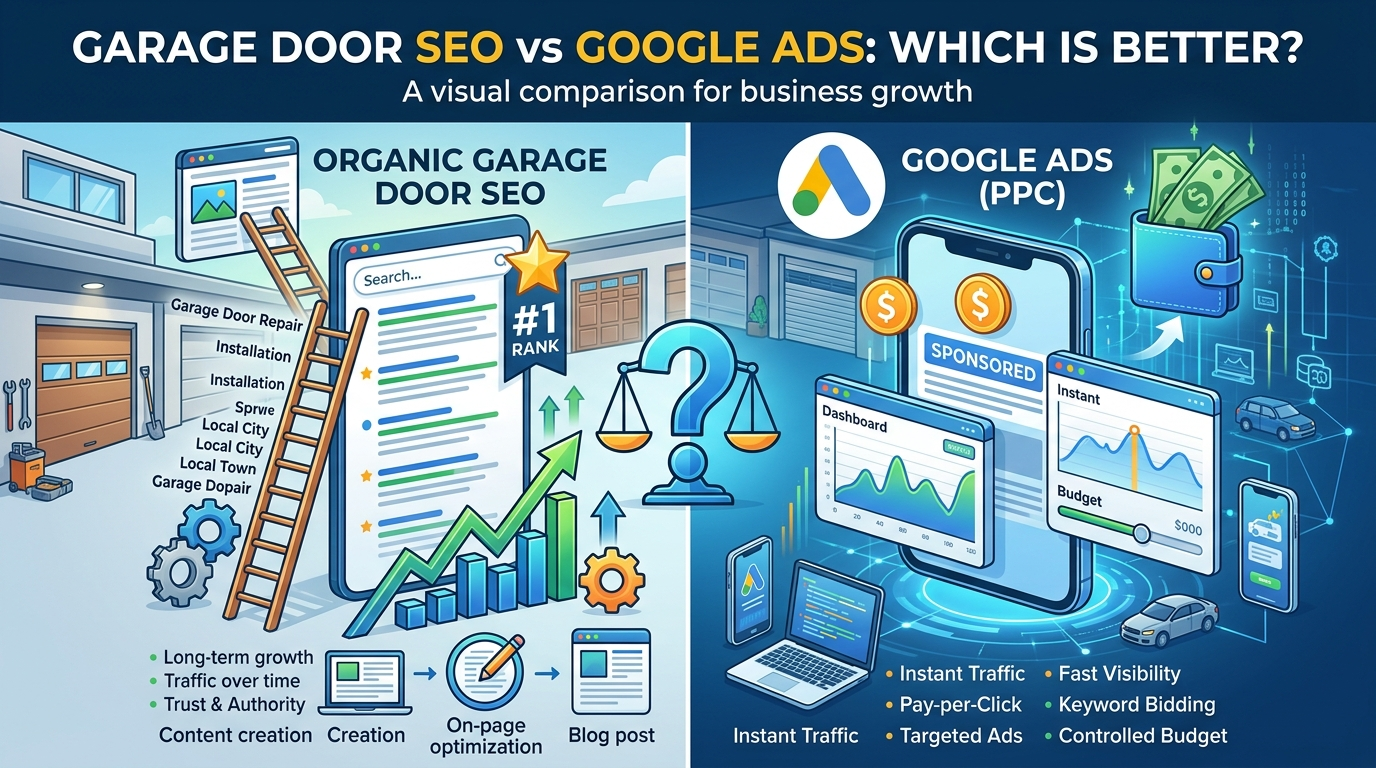
Every garage door company owner eventually asks the same question: should I put my marketing budget into SEO, into Google Ads, or both? It’s a fair question, because both channels put you in front of the same searcher, someone typing “garage door repair near me” with a broken door and a limited amount of patience. But SEO and Google Ads get you there in very different ways, with different costs, timelines, and long-term outcomes. This is a deep, side-by-side breakdown to help you decide what’s right for your business, and where each one actually fits.
Google Ads is rented visibility. You pay for a position at the top of the search results, and the moment you stop paying, that visibility disappears. SEO is owned visibility. It takes time and consistent effort to build, but once you’re ranking well, you don’t pay per click to stay there you’re capturing traffic organically, day after day, without an ongoing per-lead cost.
That single distinction rented versus owned is the foundation for almost every other difference between the two channels.
This is where Google Ads clearly wins. Launch a well-structured campaign today, and you can be getting calls within hours. For a garage door company, that speed has real value, especially for a new business, a slow season, or a location expansion where you need leads immediately rather than in six months.
SEO, by contrast, is slow by design. Depending on your market’s competitiveness, it can take anywhere from three to twelve months to see meaningful ranking movement, and longer to dominate competitive terms like “garage door repair” in a mid-sized or large metro area. If you need calls this week, SEO alone won’t get you there.
Verdict: Google Ads wins on speed, decisively.
Here’s where the comparison gets more nuanced. Google Ads has a cost per click that you pay every single time someone clicks your ad whether or not they call, and whether or not they hire you. In competitive garage door markets, cost per click on high-intent terms can add up quickly, and that cost never goes away. Every lead, forever, comes with an ad spend attached.
SEO has an upfront and ongoing investment too, content creation, technical optimization, link building, and often an SEO provider’s monthly fee. But once a page ranks well, it can continue generating calls for months or years without paying per click. The cost per lead from organic traffic tends to decrease over time as your rankings stabilize, while the cost per lead from ads stays relatively constant (or increases as competition grows).
Verdict: Google Ads costs more per lead over the long run; SEO becomes more cost-efficient the longer it’s maintained — but it requires patience and consistent investment to get there.
Search behavior data consistently shows that organic results get a meaningful share of clicks even when ads are present above them, because many users have learned to associate the “Ad” label with paid promotion and instinctively scroll past it especially for higher-stakes decisions like letting a repair company into their home.
That doesn’t mean ads don’t get clicked they clearly do, especially for urgent searches where speed matters more than skepticism. But for research-stage searches (someone comparing companies, checking pricing, or reading reviews before deciding), organic listings and content tend to carry more inherent trust.
Verdict: Ads win for urgent, ready-to-call searches. Organic results tend to win trust for research-stage searches.
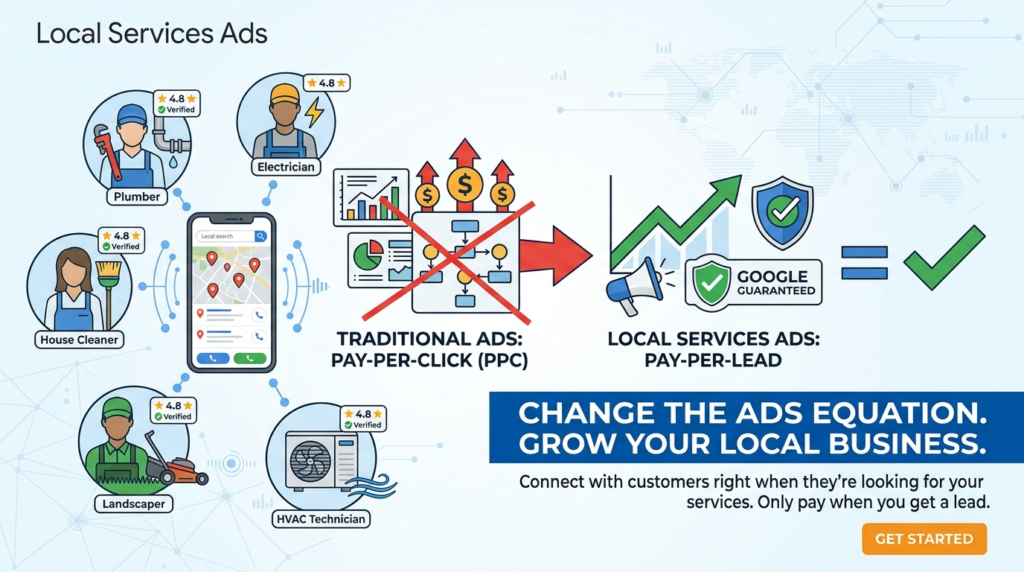
It’s worth calling out that Google’s Local Services Ads (LSA) product, not traditional search ads, is increasingly the dominant paid format for home service businesses like garage door repair. LSAs appear above both traditional ads and organic results, display your review rating and a Google Guaranteed badge, and charge per lead instead of per click. This changes some of the cost-efficiency conversation, since you’re not paying for clicks that don’t convert, but you’re still paying per lead indefinitely, and eligibility depends heavily on maintaining strong reviews and licensing verification.
This is one of the most overlooked parts of the comparison. SEO builds a genuine business asset, a website with authority, rankings, and content that keeps generating leads with no ongoing per-click cost. If you ever sell the business, that organic visibility has real value baked into it.
Google Ads builds no such asset. Stop paying, and your visibility disappears the same day. There’s no residual value sitting in a paused ad account. This doesn’t make ads a bad investment it just means the return exists only while you’re actively spending.
Verdict: SEO builds a long-term asset. Google Ads does not.
Google Ads gives you precise control. You choose which keywords to target, which locations to show up in, what your ad copy says, and how much you’re willing to spend per day. You can pause a campaign instantly if leads slow down, or scale up quickly during storm season or peak demand periods.
SEO offers far less direct control. You can’t simply “turn up” your rankings when you want more leads — you’re at the mercy of algorithm updates, competitor activity, and the time it takes content and authority to build. This makes SEO a poor fit for short-term, reactive needs, but a strong fit for steady, predictable long-term demand.
Verdict: Google Ads wins on control and flexibility.
In isolation, this depends heavily on your market. In a low-competition area, a well-optimized website might dominate organic results and out-produce ads on cost per lead. In a highly competitive metro area, ranking organically for “garage door repair” might take a serious sustained investment, making ads the more realistic near-term source of volume.
But in practice, most garage door companies that consistently generate a strong volume of calls aren’t relying on just one channel — they’re running both, and letting each one do what it’s naturally best at.
The strongest strategy usually isn’t SEO vs. Google Ads, it’s SEO and Google Ads, deployed with a clear division of labor:
If you’re choosing where to put your first dollars, consider:
Google Ads and garage door SEO aren’t really competing strategies they’re solving different problems on different timelines. Ads buy immediate visibility and calls, at a cost that never disappears. SEO builds visibility and trust that compounds over time, but demands patience before it pays off. The garage door companies that dominate their market long-term are rarely the ones that picked one over the other they’re the ones that used ads to generate calls while SEO quietly built the asset that eventually makes those ads less necessary.
Keep reading
 Blog
Blog A lot of garage door companies build a website with a homepage, a services page, and a contact page — […]
 Blog
Blog SEO takes months to pay off. Google Ads can start ringing your phone today. For garage door companies, where a […]
 Blog
Blog If your garage door company isn’t showing up when someone searches “garage door repair near me,” you’re handing free jobs […]
Marketing
Reviews, local SEO and a website that is easy to use work best together. Tell us about the business and we’ll tell you, plainly, what we would do next.