
Garage Door SEO vs Google Ads: Which Is Better?
Every garage door company owner eventually asks the same question: should I put my marketing budget into SEO, into Google […]
You do good work. Your crew shows up on time, your equipment is dialed in, and the customers you do get almost always come back or send a referral. So why does…
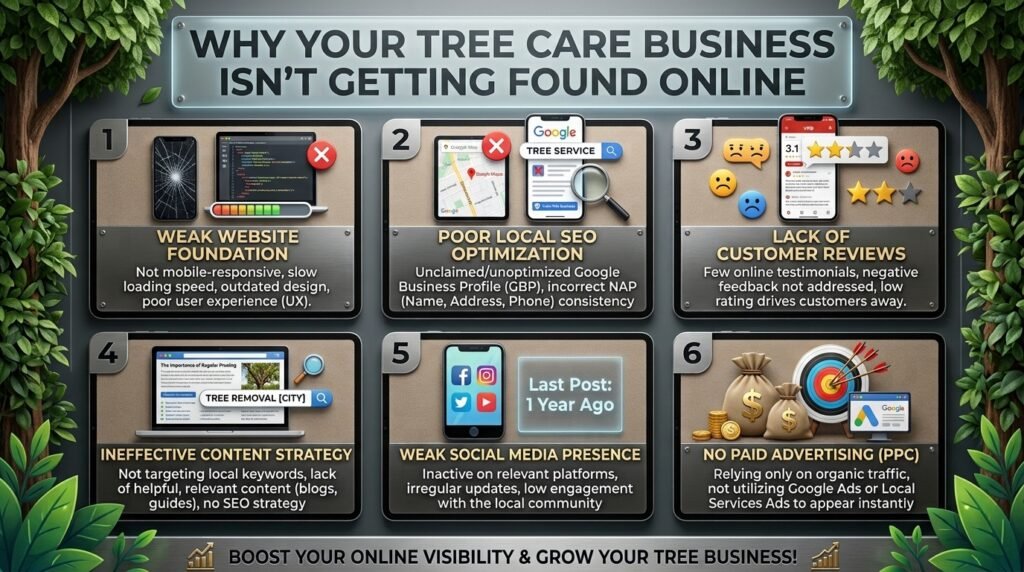
You do good work. Your crew shows up on time, your equipment is dialed in, and the customers you do get almost always come back or send a referral. So why does the phone stay quiet for days at a stretch while the tree company two towns over seems to have trucks running non-stop?
Nine times out of ten, the answer has nothing to do with the quality of your tree work. It has to do with the fact that when someone in your service area types “tree removal near me” or “emergency tree service” into Google, your business simply isn’t part of the conversation. You’re invisible at the exact moment someone is ready to hire.
This isn’t a mystery, and it isn’t bad luck. There’s a specific set of reasons tree care companies fall out of local search results, and almost all of them are fixable without hiring a full marketing department. Let’s go through them one at a time.
For a local service business like tree care, the Google Business Profile (formerly Google My Business) is arguably more important than your actual website. It’s what shows up in the map pack, those three listings with a mini-map that appear above the regular search results for local searches. Most people never scroll past that map pack.
Here’s where tree companies typically go wrong with their profile:
A fully built-out, regularly updated profile with the right categories, accurate service areas, and fresh photos will often do more for your lead flow than a brand-new website ever could.
Reviews do double duty. They’re a major ranking factor for local search, and they’re the single biggest trust signal for someone deciding between you and three other tree companies with a five-star average.
The tree companies that struggle usually fall into one of two camps. Either they’ve never built a habit of asking satisfied customers for a review — the job wraps up, everyone goes home, and the moment passes, or they have reviews but never respond to them, which makes the business look absent even when it isn’t.
A simple, repeatable system fixes this: ask for the review at the moment of highest satisfaction, which for tree work is usually right after cleanup, when the yard looks better than it did before you arrived. Send a direct link by text so there’s no searching involved. And respond to every review, good or bad, within a few days. A thoughtful reply to a negative review often does more for your credibility than ten five-star reviews with no engagement at all.
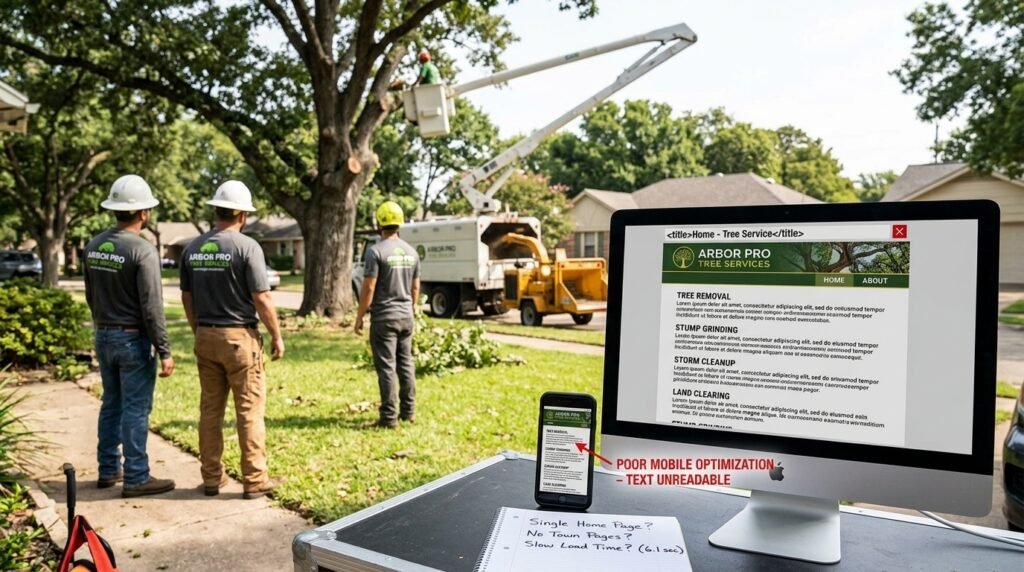
A lot of tree service websites look fine to the human eye and are still invisible to search engines, because looking good and being structured correctly are two different things. Common issues include:
A citation is any mention of your business name, address, and phone number (often shortened to NAP) on another website: directories, industry associations, chambers of commerce, and review platforms. Search engines use these citations to verify that your business is real, legitimate, and located where you say it is.
The problem shows up when a business has changed its phone number, moved locations, or rebranded at some point, and the old information is still sitting on directory sites that were never updated. Inconsistent NAP data across the web actively confuses search engines and can suppress your local rankings, even if your Google Business Profile itself is accurate.
A periodic audit of where your business is listed, and a cleanup pass to make sure the name, address, and phone number match exactly everywhere, is unglamorous work that pays off steadily.

Most tree companies optimize for “tree service” and maybe “tree removal” and stop there. But the actual language people use when they need tree work covers a lot more ground: storm damage cleanup, hazard tree assessment, tree trimming near power lines, stump grinding cost, emergency tree removal, tree removal permit requirements, and dozens of seasonal and problem-specific phrases.
Each of those represents a real person with real intent, searching in a moment when they’re close to hiring someone. If your content only speaks to the two or three broadest terms, you’re ceding all of that other search volume to competitors who bothered to write about it.
This is also where local seasonality matters. Searches for storm damage cleanup spike immediately after severe weather. Searches for pruning spike in late winter and early spring. A content plan that anticipates these spikes, rather than reacting to them puts you in front of customers before your competitors even think to update their site.
Backlinks other websites linking to yours remain one of the strongest signals search engines use to judge whether a business is trustworthy and established. Tree care companies often have zero strategy here, which means zero backlinks, which means an uphill climb against competitors who’ve built even a modest handful.
Realistic ways to build these without an unnatural amount of effort include getting listed with your local chamber of commerce, sponsoring a youth sports team or community event, partnering with related local businesses (landscapers, roofers, real estate agents) for mutual referral links, and getting featured in local news coverage after storm response work which tree companies are often uniquely positioned to provide.
Tree care is visual work. Before-and-after photos, video of a difficult removal near a structure, and documentation of storm response are some of the most persuasive content a service business can have, and yet many tree company websites have almost none of it, or bury what they do have in a single low-resolution gallery.
Potential customers deciding between companies for a genuinely risky job (a large tree leaning toward a house, a hazardous limb over a driveway) want to see evidence that you’ve handled situations like theirs before. That evidence, published consistently, also happens to be exactly the kind of fresh, specific content that search engines favor over generic stock-photo websites.
Even a well-ranked page loses the customer if it isn’t obvious what to do once someone lands on it. A phone number buried in a footer, a contact form with ten required fields, or no clear call-to-action at all will cost you leads that the SEO work already earned. Every page should make the next step, call, text, or fill out a short form immediate and unmistakable, especially on mobile.
None of this requires a marketing degree, and it doesn’t require doing everything at once. A realistic starting order looks like this:
For local search, most businesses start seeing movement in the map pack within four to eight weeks of properly optimizing their Google Business Profile, assuming the category, service area, and photos are all corrected. Ranking well for competitive website keywords, on the other hand, usually takes three to six months of consistent content and citation work, sometimes longer in crowded metro areas.
Yes. A Business Profile alone caps how much information you can share, and Google still uses your website as a trust signal when deciding how high to rank your profile in the map pack. Businesses relying only on their profile also lose out on all the website-based searches for specific services, service-area towns, and informational questions.
Start with the Google Business Profile. Confirm the primary category is accurate, list every service you actually offer, define your service area by town or zip code, and add at least ten current photos of real jobs. This single fix tends to move the needle faster than anything else on this list.
There’s no fixed number, but as a rule of thumb, you want to be within striking distance of whichever competitor currently holds the top map pack spots, both in review count and in average rating. If they have 80 reviews at 4.8 stars, having 12 reviews at 5 stars won’t be enough on its own; volume and recency both matter to the algorithm.
It can be, especially for storm cleanup and emergency removal searches where intent is immediate and organic rankings take time to build. Many tree companies run ads for the highest-urgency terms while the slower organic and local SEO work builds in the background, then scale ads back once organic rankings are established.
Tree care businesses that work through this list steadily, rather than trying to fix everything overnight, tend to see the shift happen gradually and then all at once, first showing up for a handful of searches, then holding a spot in the map pack, then becoming the company people recognize by name before they’ve even called. The work you’re already doing in the field is the easy part. Making sure the right people can find you before they call someone else is the part that’s been missing.
Keep reading
 Blog
Blog Every garage door company owner eventually asks the same question: should I put my marketing budget into SEO, into Google […]
 Blog
Blog A lot of garage door companies build a website with a homepage, a services page, and a contact page — […]
 Blog
Blog SEO takes months to pay off. Google Ads can start ringing your phone today. For garage door companies, where a […]
Marketing
Reviews, local SEO and a website that is easy to use work best together. Tell us about the business and we’ll tell you, plainly, what we would do next.