
Garage Door SEO vs Google Ads: Which Is Better?
Every garage door company owner eventually asks the same question: should I put my marketing budget into SEO, into Google […]
Walk down any street after a storm and you’ll see the same three words painted on the side of half the trucks parked in front of damaged trees: licensed and insured. It’s…
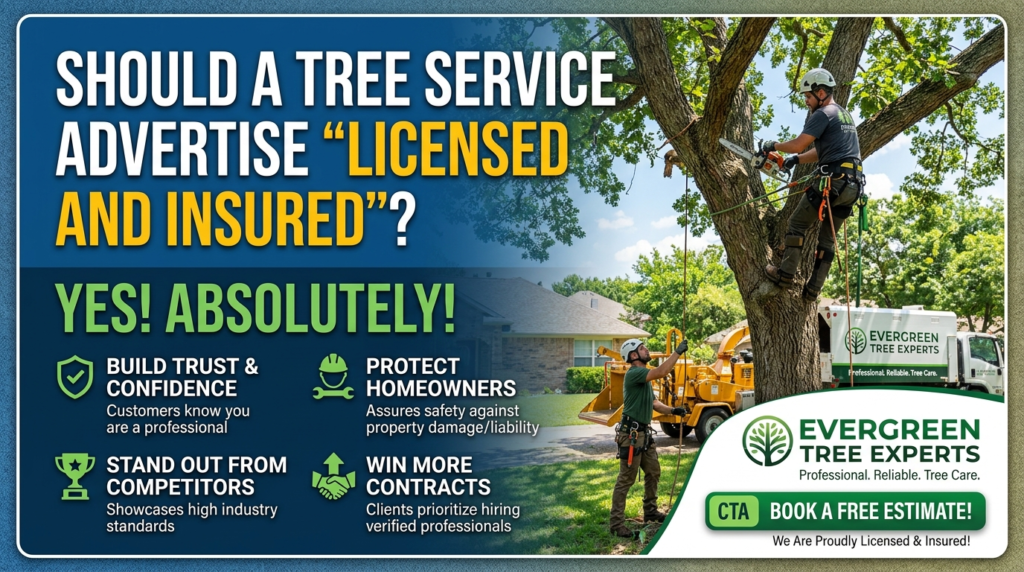
Walk down any street after a storm and you’ll see the same three words painted on the side of half the trucks parked in front of damaged trees: licensed and insured. It’s become so common that most tree companies slap it on their website, their business cards, and their door magnets without thinking twice about it.
But should you actually be advertising it? And if so, how do you do it in a way that means something, instead of blending into the wallpaper of every other truck on the block?
Short answer, yes, you should advertise it, but only if it’s true, only if you can back it up, and only if you say it in a way that actually sets you apart instead of repeating a phrase that’s become nearly meaningless through overuse. Here’s the full picture.
The phrase used to mean something. Now it’s printed on so many trucks, including trucks belonging to companies that aren’t actually licensed or properly insured, that homeowners have learned to treat it as background noise rather than a real credential.
Several tree industry sources point out exactly this problem. One industry piece on tree company insurance put it bluntly: companies that advertise “fully insured” often don’t understand what coverage is actually required, and in many markets only a small number of tree companies genuinely carry proper liability and workers’ compensation coverage. Government consumer-protection resources echo the same warning, noting that unlicensed tree businesses will sometimes go as far as displaying fraudulent license numbers or falsely claiming to be bonded and insured.
That’s the core problem with the phrase as most companies use it: it’s unverifiable at a glance, it’s said by companies who don’t actually carry it, and it’s said by companies who do, which means the customer standing on their lawn comparing three estimates has no easy way to tell which is which.
That doesn’t mean you shouldn’t say it. It means saying it alone isn’t enough anymore.
Before advertising anything, it’s worth being precise about what each word covers, because customers who’ve done even a little research will notice if you’re vague.
Licensed means your business holds whatever credential your state, county, or city requires to legally perform tree work. This varies significantly by location. Some states require a dedicated tree expert license separate from a general contractor’s license. Others fold tree work into a broader landscaping or arborist license, and some municipalities layer city-level licensing requirements on top of state ones. A few states have minimal or no licensing requirements at all for tree work specifically, which makes insurance and certification carry even more of the trust burden.
Insured typically needs to cover two distinct things, not one: general liability insurance, which covers property damage (a limb through a roof, a chipper nicking a fence), and workers’ compensation insurance, which covers injury to your own crew. Tree work carries a genuinely high injury rate, and a company that carries liability coverage but skips workers’ comp is only half covered. Coverage amounts also vary widely comprehensive policies can run anywhere from a few hundred thousand dollars to several million in coverage, and premiums for more extensive policies can run into the thousands annually depending on company size and the scope of work performed.
Bonded is a separate concept that often gets bundled in with “licensed and insured” even though it means something different. A bond is a financial guarantee that protects the customer if the company fails to complete a job or fails to pay for damages or subcontractors. Not every state requires it for tree services, but where it applies, it’s worth naming specifically rather than folding it into the generic phrase.
If you’re going to advertise your credentials, being specific about which of these you actually carry and being ready to name your coverage limits when asked does more for your credibility than the three-word phrase ever will on its own.

Given how diluted the phrase has become, it might seem like the smarter move is to drop it altogether and let your work speak for itself. That would be a mistake, for a few reasons.
Customers are actively told to ask for it. Government and consumer-advice sources consistently instruct homeowners to verify a tree company is licensed and insured before hiring, and to request proof of both before work begins. If a homeowner is actively screening for this and your site or estimate doesn’t mention it at all, you risk getting filtered out before you ever get the chance to explain your actual coverage.
Its absence reads as a red flag, even if the phrase itself is common. A company that says nothing about licensing or insurance creates more doubt than one that says the generic phrase and a company that gets specific creates the most trust of all.
It matters more after storms, when scrutiny is highest. Severe weather brings out a wave of unlicensed, uninsured operators looking to undercut established companies on price. Consumer-protection agencies specifically warn homeowners about this pattern after major storms. If your business is properly covered, this is exactly the moment that credential does the most work for you but only if it’s visible and specific, not generic.
It affects how you get chosen among multiple quotes. When a homeowner is comparing three estimates that are close in price, credentials often become the deciding factor, especially for higher-risk jobs like large removals near structures or work around power lines.
The failure isn’t in saying “licensed and insured.” It’s in stopping there. Here’s what separates a credential that builds real trust from one that gets scrolled past:
Once you’ve decided to advertise your credentials properly, the placement matters as much as the wording.
This is worth stating plainly, because the temptation to round up exists in every industry. Falsely advertising licensing or insurance that a business doesn’t actually carry isn’t just an ethical problem it’s frequently a legal one. Multiple state and municipal consumer-protection resources describe unlicensed operators who advertise fraudulent license numbers or false insurance claims as engaging in exactly the kind of deceptive practice that licensing boards and consumer protection agencies actively pursue. Beyond the legal exposure, a single customer who checks and finds the claim false will cost you far more in reputation damage through reviews and word of mouth than any job you might have won by claiming it.
If you’re not currently licensed, insured, or both, the honest and strategically smarter move is to fix that gap before advertising around it, not to advertise past it.
It depends entirely on your state, county, and sometimes your city. Some jurisdictions require a dedicated tree expert or arborist license, others fold tree work into a general contractor’s license, and a few have minimal specific requirements. Check with your state’s licensing board or department of consumer affairs to confirm exactly what applies to your location before advertising any credential.
Insurance protects against injury and property damage during the work itself. A bond is a separate financial guarantee that protects the customer if your business fails to complete a job or doesn’t pay for damages it caused. They’re often advertised together, but they cover different risks, and naming both specifically is stronger than lumping them into one vague phrase.
Yes. A visible license number lets homeowners verify it independently on their state or local licensing board’s website, which builds far more trust than the word “licensed” on its own. Several states also legally require licensed tree companies to display their license number on vehicles.
Not really, and industry sources specifically call this out the phrase gets used loosely enough by companies that don’t fully understand their own coverage that it’s lost most of its meaning to informed customers. Naming your actual coverage types (general liability and workers’ compensation) and, ideally, your coverage amount, carries much more weight.
For close comparisons between similarly priced quotes, yes credentials are frequently the deciding factor, especially for higher-risk jobs like large removals near a home or work around utility lines. It matters even more in the period right after major storms, when a wave of unlicensed operators typically enters the market and scrutiny from homeowners is highest.
Report it to your state licensing board or local consumer protection office if you have solid reason to believe it’s fraudulent several states actively investigate this. In the meantime, the best response is making your own credentials as specific and verifiable as possible, since vague, unverifiable claims from a competitor become easy to outshine once you’re naming license numbers and coverage amounts instead of repeating the same generic phrase.
It serves a different purpose. Licensing and insurance are about legal compliance and financial protection. Certification speaks to technical skill and judgment assessing tree health, structural risk, and proper technique. Multiple municipal and industry sources recommend homeowners look for both, since one doesn’t substitute for the other.
Yes, advertise it but treat “licensed and insured” as a starting point, not a finished sentence. The phrase alone has been worn down by overuse and outright misuse to the point where it barely registers with an informed customer. What still works is specificity: your actual license number, your actual coverage types and amounts, your willingness to hand over documentation without being asked twice, and where a customer can go to verify all of it themselves. That’s the version of “licensed and insured” that still means something and it’s the version that turns a tired marketing phrase back into the trust signal it was always supposed to be.
Keep reading
 Blog
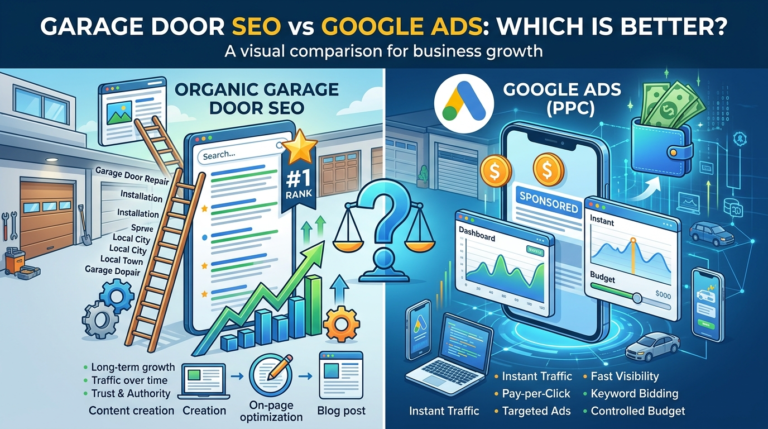
Blog Every garage door company owner eventually asks the same question: should I put my marketing budget into SEO, into Google […]
 Blog
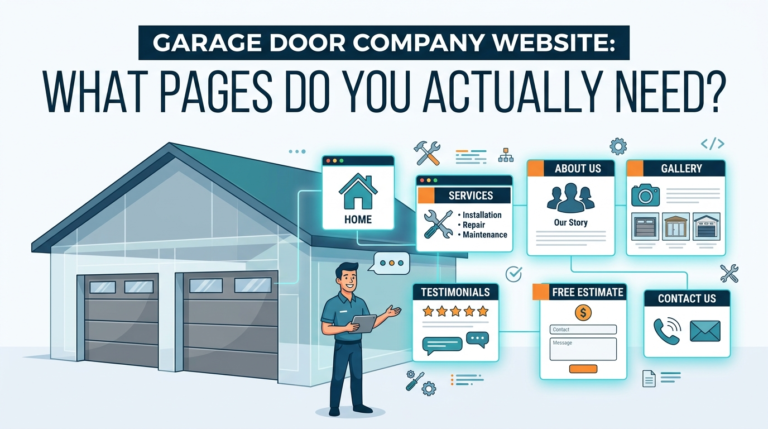
Blog A lot of garage door companies build a website with a homepage, a services page, and a contact page — […]
 Blog
Blog SEO takes months to pay off. Google Ads can start ringing your phone today. For garage door companies, where a […]
Marketing
Reviews, local SEO and a website that is easy to use work best together. Tell us about the business and we’ll tell you, plainly, what we would do next.