
Garage Door SEO vs Google Ads: Which Is Better?
Every garage door company owner eventually asks the same question: should I put my marketing budget into SEO, into Google […]
There are two kinds of tree companies in every town: the ones whose phone rings every time someone searches “tree removal near me,” and the ones doing equally good work who never…

There are two kinds of tree companies in every town: the ones whose phone rings every time someone searches “tree removal near me,” and the ones doing equally good work who never show up at all. The difference almost never comes down to skill with a chainsaw. It comes down to whether the business has actually been set up to be found.
This guide walks through everything that goes into that not a quick checklist, but the full picture: how local search actually ranks tree companies, what to fix on your Google Business Profile, how to structure a website that search engines and homeowners both understand, and what ongoing work keeps you there once you arrive.
Tree service SEO is the process of getting your business to show up when people in your area search for tree-related help, both in the regular organic results and in the local “map pack” that appears above them for local searches. It’s different from running ads. Paid search buys temporary visibility, SEO builds visibility that keeps working without a per-click cost, though it takes longer to establish.
For this industry specifically, the searches that matter most tend to combine a service with a location, “tree removal Springfield,” “tree trimming near me,” “emergency storm cleanup [city]” — which means local SEO, not generic national SEO, is where almost all of the effort should go.
Google’s local algorithm evaluates every business against three factors, and understanding them changes how you prioritize your time.
Proximity — how close your business is to the person searching. You can’t directly control this, but you can influence how Google interprets your service radius through your Business Profile settings and location-specific content.
Relevance — how well your business matches what was searched. This is where category selection, service descriptions, and content quality do the heavy lifting.
Prominence — how well-known and well-regarded your business is, based on signals like review volume and quality, backlinks, citations, and general online visibility.
Almost everything in this guide maps back to improving relevance and prominence, since proximity is largely out of your hands.
If you fix nothing else, fix this. For local service businesses, the Business Profile frequently drives more calls than the website itself, because it’s what appears in the map pack — the three listings with a mini-map that sit above the standard organic results for local searches.
Category selection matters more than most owners realize. Set your primary category as precisely as possible — “Tree Service” rather than a generic landscaping category — and add relevant secondary categories like arborist, tree trimming service, or stump removal service if they apply to your business.
Completeness is a ranking factor, not just a nice-to-have. Profiles with every field filled in, services, service area, business hours, phone number, website — consistently outperform partial profiles. Define your service area by specific towns or zip codes rather than leaving it to Google’s default radius guess, which is frequently wrong.
Photos need to be real and current. Actual crew photos, equipment in use, and before-and-after shots of real jobs perform better than stock imagery or old photos that haven’t been refreshed in years. Update this regularly, not once and never again.
Reviews function as fuel for this whole system, which deserves its own section below.
Ongoing activity signals a business that’s actually operating. Regular posts, updated photos, and prompt responses to questions and reviews all contribute to how “alive” your profile appears to Google, and a profile that goes quiet for months tends to lose ground even if nothing else about the business changed.
Most tree companies stop at two or three broad keywords and leave enormous search volume on the table. A proper keyword approach covers several layers:
Keyword research tools can help you find which of these actually get searched in your area and estimate how competitive each one is, which matters when deciding whether to go after a broad term dominated by large companies or a more specific one you can realistically win.
A website can look professional and still be nearly invisible to search engines if it isn’t structured correctly. The most common structural problems in this industry:
One page trying to do everything. A homepage with a paragraph on removal, a paragraph on trimming, and a paragraph on stump grinding gives search engines nothing specific to associate with any one of those searches. Each core service deserves its own dedicated page with real depth — what the service involves, how you approach it, typical scenarios, and relevant photos of that specific type of job.
No dedicated pages for the towns you serve. A single generic “service area” page listing town names in the footer does very little. A separate page for each of your main service towns, written with real, specific content rather than duplicated boilerplate with the town name swapped in is what actually shows up for “[service] in [town]” searches.
Weak or missing metadata. Every page needs a specific, keyword-relevant title tag and meta description. Generic titles like “Home” or “Services” waste the clearest signal you can give search engines about what a page covers.
Technical basics left unaddressed. Your site needs to run on HTTPS rather than HTTP, most hosts provide free SSL certificates, so there’s rarely a good reason not to. Google Search Console should be set up to catch crawl errors, broken links, and indexing problems before they quietly suppress your rankings.
Slow load times. Tree service sites tend to be photo-heavy, which is good content handled badly if the images aren’t compressed and optimized. A page that takes several seconds to load loses visitors before they see anything, and Google factors load speed into rankings directly.
Not built mobile-first. A large share of tree service searches especially urgent ones happen on a phone, often during or right after a storm. A site that’s hard to navigate on mobile, or where the phone number isn’t a tappable link, costs you the call to whichever competitor made that one step easier.
Images without alt text. Every photo should have descriptive alt text that includes what’s shown and, where relevant, the location — this is a straightforward win that a large share of tree company sites still skip entirely.
No schema markup. Structured data (schema) helps search engines understand exactly what your business is, what services you offer, and what questions your FAQ content answers, which can help you earn richer, more prominent search result listings.
Reviews influence local rankings directly, and they influence something just as important — whether a homeowner comparing three companies actually picks up the phone and calls you instead of scrolling to the next listing. The volume, rating, and recency of your reviews all factor in, and a steady trickle of five to ten new reviews a month tends to matter more for rankings than a large pile of old reviews that stopped growing years ago.
The system that works best is simple and repeatable: ask right at the moment satisfaction peaks, which for tree work is typically right after cleanup, when the yard or property looks visibly better than before you arrived. Send a direct link by text rather than asking someone to search for you later, since that gap is where most requests quietly die. And respond to every review — good and bad — since a business that’s visibly engaged with its own reviews reads as more trustworthy than one with reviews sitting unanswered for months.
A citation is any mention of your business name, address, and phone number on another website — directories, industry associations, chambers of commerce, and review platforms. Search engines use these to help confirm your business is legitimate and located where you say it is.
The trouble shows up when a business has moved, changed its number, or rebranded, and old directory listings never got updated. Inconsistent information across these citations actively confuses search engines and can drag down local rankings even when your Business Profile itself is accurate. Beyond the major general directories, industry-specific listings — sites built specifically for landscaping and tree care businesses — can add credibility on top of the basic citation value.
A periodic audit and cleanup pass, making sure your name, address, and phone number match exactly everywhere they appear, is unglamorous but steady-paying work.
Backlinks, other websites linking to yours, remain one of the strongest signals search engines use to judge how established and trustworthy a business is. Most tree companies have never pursued this deliberately, which leaves an opening for the ones who do.
Realistic, sustainable ways to build these include getting listed with your local chamber of commerce, sponsoring a local team or community event, cross-linking with related local businesses like landscapers, roofers, or real estate agents, and getting featured in local news after storm-response work, something tree companies are frequently positioned to provide when severe weather hits.
Beyond service and location pages, ongoing content, blog posts, guides, and FAQ sections, gives you more surface area to rank for the informational searches mentioned earlier, and it gives Google fresh, regularly updated signals that the site is active. This is also where before-and-after photo documentation and short write-ups of difficult or notable jobs do double duty: they’re persuasive to potential customers deciding on a risky job, and they’re exactly the kind of specific, non-generic content search engines favor over thin, templated pages.
FAQ-style content deserves particular attention, since well-structured questions and answers, especially when paired with schema markup — have a real chance at earning featured snippet placement above the normal organic results.
Every bit of ranking work above is wasted if a visitor lands on your site and doesn’t immediately know what to do next. A phone number buried in a footer, a contact form asking for ten fields, or a page with no clear next step will quietly bleed leads that the SEO work already earned. Every page should make calling, texting, or submitting a short form the obvious, immediate next action especially on mobile, where hesitation costs you the fastest.
This is worth being direct about, because a lot of marketing content glosses over it. Movement in the Google Business Profile and map pack can start appearing within four to eight weeks of properly fixing the profile itself. Meaningful movement on competitive website keywords typically takes three to six months of consistent work, sometimes longer in crowded metro markets. This isn’t a switch that flips it’s compounding work, and the businesses that treat it as a one-time setup rather than an ongoing effort tend to plateau or slide backward once competitors catch up.
Many tree companies run paid search campaigns alongside this organic work specifically to cover that gap capturing urgent, high-intent searches immediately while the slower organic rankings build underneath.
Track it deliberately rather than guessing. Google Business Profile insights show how customers are finding your listing and what actions they take once they do. Google Search Console shows which queries are actually bringing traffic to your site and flags technical problems early. Call tracking, even a simple version, tells you which pages and channels are producing actual leads rather than just traffic. Reviewing this monthly, rather than only when business feels slow, is what turns SEO from a guessing game into a system you can steadily improve.
Local Business Profile improvements can show movement within four to eight weeks. Website-based organic rankings for competitive keywords generally take three to six months of consistent work, and sometimes longer in crowded markets. It compounds over time rather than delivering results overnight.
They serve different purposes rather than competing directly. Ads deliver immediate visibility for a per-click cost and stop the moment you stop paying. SEO takes longer to build but keeps producing visibility without an ongoing per-lead cost once established. Many tree companies run both together — ads for immediate demand, SEO for the long-term foundation.
For most tree companies, it’s the Google Business Profile — correcting the category, filling out every field, defining the service area precisely, and adding real, current photos. This tends to move the needle faster than anything else on this list because it directly controls map pack visibility.
For your two or three core service towns, yes, with real, specific content rather than a template with the town name swapped in. For smaller or outlying towns with low search volume, a shorter mention within a broader regional page usually covers it, a thin, near-duplicate page for every small town can hurt more than it helps.
There’s no fixed number — it’s relative to whoever currently holds the top spots in your market’s map pack. A steady flow of new reviews each month tends to matter more for rankings than a large but stagnant pile of old ones.
A lot of the foundational work — the Business Profile, review requests, basic on-page fixes — is genuinely doable in-house with time and consistency. Ongoing technical SEO, content production at scale, and backlink building tend to be where owners run out of time first, which is often where outside help becomes worth the cost.
It still helps, provided the content is genuinely useful and specific rather than generic filler. Informational content answering real questions people search before they’re ready to hire, along with documented before-and-after work, gives you more searchable surface area and signals an active, credible business.
None of this needs to happen at once, and trying to do it all simultaneously usually means nothing gets finished properly. A sensible order: fully build out the Google Business Profile first, put a consistent review request system in place, fix the core technical and structural issues on your website, build out dedicated service and location pages, clean up your citations, and then layer in ongoing content and backlink building as ongoing habits rather than one-time tasks. Tree companies that work through this steadily tend to see it happen the same way most compounding work does — slowly at first, then all at once, until the business that used to wonder where the calls went becomes the one competitors are trying to catch.
Keep reading
 Blog
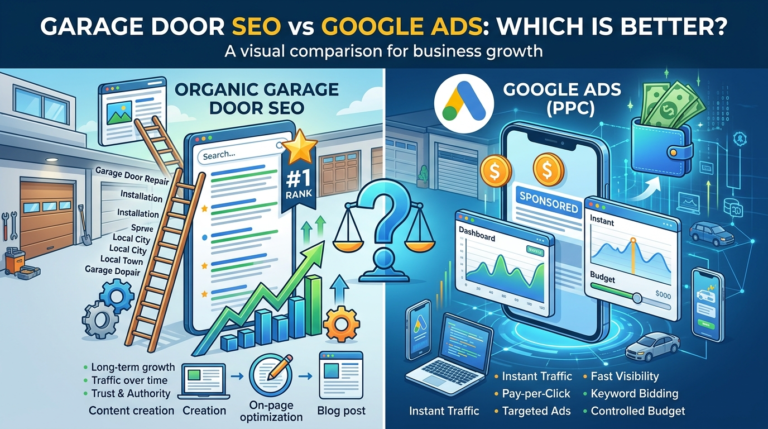
Blog Every garage door company owner eventually asks the same question: should I put my marketing budget into SEO, into Google […]
 Blog
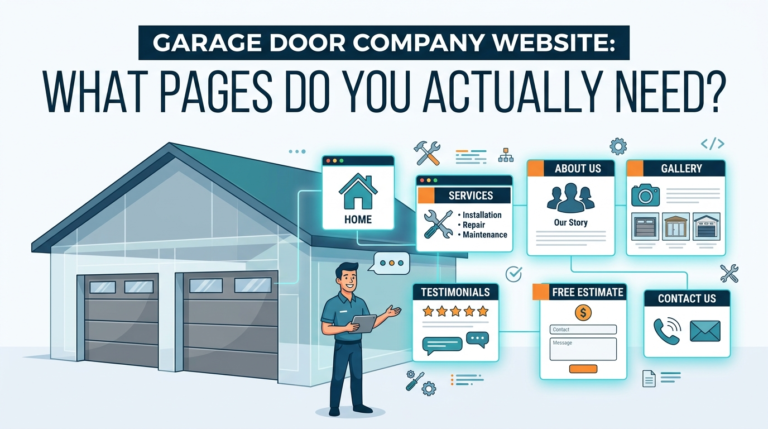
Blog A lot of garage door companies build a website with a homepage, a services page, and a contact page — […]
 Blog
Blog SEO takes months to pay off. Google Ads can start ringing your phone today. For garage door companies, where a […]
Marketing
Reviews, local SEO and a website that is easy to use work best together. Tell us about the business and we’ll tell you, plainly, what we would do next.