
Garage Door SEO vs Google Ads: Which Is Better?
Every garage door company owner eventually asks the same question: should I put my marketing budget into SEO, into Google […]
When a homeowner has a tree leaning toward their roof after a storm, they don’t scroll through search results. They look at the three listings sitting at the top of the page…
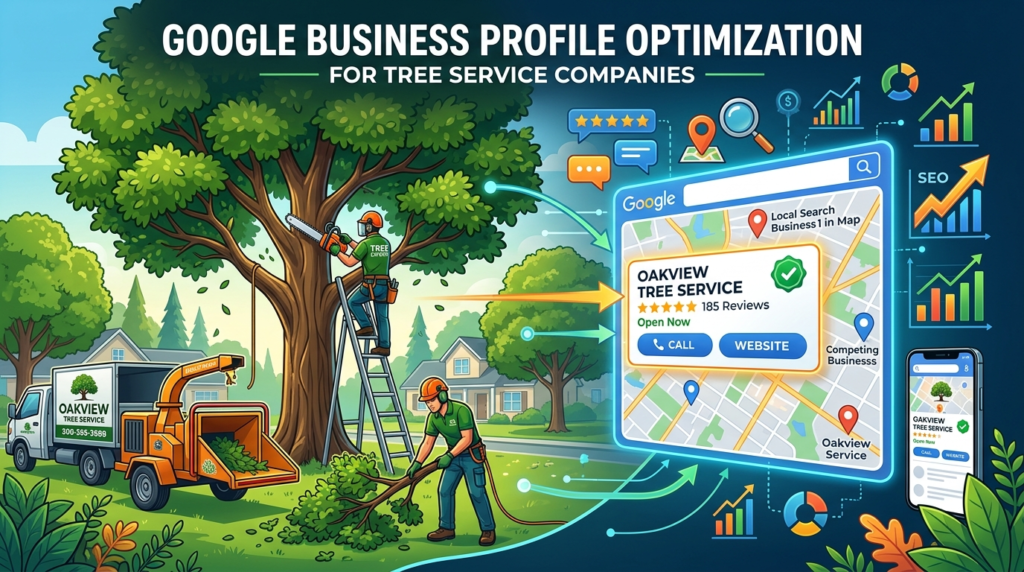
When a homeowner has a tree leaning toward their roof after a storm, they don’t scroll through search results. They look at the three listings sitting at the top of the page with the little map next to them, and they call one of those three companies. If your business isn’t one of those three, it doesn’t matter how good your work is. You never got the chance to prove it.
That top spot is called the local map pack, and it’s controlled almost entirely by your Google Business Profile. For tree service companies specifically, this single listing often drives more calls than the website does, because it’s the first thing a stressed, urgent searcher sees. This guide covers every part of getting that profile built and maintained the right way, without skipping the details that most guides gloss over.
This sounds obvious, but a surprising number of tree companies either never claimed their profile or claimed it years ago and haven’t touched it since. Search for your business name on Google, select the option to claim or manage the listing, and complete Google’s verification process, which usually involves a postcard, phone call, or email depending on your account setup. If you’re not sure whether your business already has an unclaimed listing sitting out there, search for it before creating a new one. Duplicate listings confuse Google and split your review count and history across two profiles instead of one.
Your business name should be your actual, real name exactly as it appears on your signage, contracts, and legal paperwork. Adding extra keywords into the name field, something like “Joe’s Tree Service Best Affordable Springfield,” might feel like a clever way to rank for more terms, but Google treats this as spam and can suspend or demote your profile for it.
Your phone number, address, and website URL need to match exactly across every place your business appears online, not just here. This is called NAP consistency (name, address, phone), and it matters more than most tree company owners realize. Audits of local directory listings regularly turn up ten or more slightly different versions of the same business’s contact details scattered across the web. That inconsistency actively confuses Google about which version is correct, and it can quietly suppress your rankings even when the profile itself looks fine.
Category selection is one of the highest leverage decisions in the entire profile, and it’s also one of the most commonly rushed. Your primary category should be “Tree Service,” not a broader category like “Landscaper” or “Gardener,” since Google treats these as meaningfully different business types even though a homeowner might use the terms loosely.
Beyond the primary category, add every relevant secondary category that genuinely applies to your business: arborist, tree trimming service, stump removal service, landscaper, or lawn care service if you offer that work too. Each additional accurate category gives Google another way to match your profile to a relevant search, but only add categories that reflect real services you provide. Padding the list with categories you don’t actually service can hurt more than it helps.
Don’t leave your service area to Google’s default guess, which is often wrong and either too narrow or too broad for what you actually cover. Set it explicitly by listing every city, town, and zip code your crews actually drive to. If certain areas only get specific services (emergency response in one zone, routine trimming in a wider one), note that distinction in your service descriptions where possible, since it helps Google connect the right searcher to the right offering rather than showing you for work you don’t perform in that area.

The services section of your profile is one of the most underused optimization opportunities tree companies have. Rather than a single line like “tree removal,” write a real description for each service you offer that naturally includes the kind of language a homeowner would actually search phrases like “tree removal in your city” or “stump grinding near [a specific neighborhood]” work into a service description far more naturally than they would if forced into your business name.
Your overall business description deserves the same care. Cover what you do, where you do it, what makes your crew qualified (certifications, years in business, licensing and insurance if applicable), and avoid generic filler that could describe any tree company in the country. Specificity is what separates a description that helps you rank from one that Google skims past.
Stock photography does almost nothing for a tree service profile, and it can actively hurt trust once a homeowner notices it isn’t your actual crew or equipment. What performs well instead is straightforward: real photos of your crew on an actual job site, your trucks and equipment in use, and before and after shots of completed trimming, removal, and stump grinding work. Crane jobs, bucket truck work, and storm cleanup photos in particular tend to build the kind of confidence a homeowner needs before calling about a large, risky job.
This isn’t a one time task. Profiles that add new photos regularly tend to hold their position better than ones with a handful of images uploaded once and never refreshed. Treat it as an ongoing habit tied to your actual job schedule rather than a launch day checklist item.
Reviews influence your ranking in the map pack directly, and they influence something equally important, which is whether a homeowner comparing your listing against two competitors actually picks up the phone. Volume, average rating, and how recent your reviews are all factor into this, and a business that’s steadily adding new reviews each month tends to outperform one sitting on an older, larger pile of reviews that stopped growing.
The moment right after a job wraps up, when the yard looks noticeably better than it did that morning and the homeowner is relieved, is the best window to ask. Sending a direct link by text at that moment, rather than asking someone to search for you later, captures far more reviews than leaving it to chance. And responding to every review you get, positive or negative, matters almost as much as collecting them in the first place. An unanswered string of reviews reads as a business that’s checked out, while thoughtful responses, even to a negative review, tend to build more trust than the negative review costs you.
Google’s own posting feature lets you share short updates directly on your profile, seasonal reminders about storm prep, a note about spring pruning season, a recent job you’re proud of, or a promotion. These posts don’t just inform potential customers scrolling past your listing. They signal to Google that the business behind the profile is actively operating, which matters for how the algorithm treats your overall visibility. A profile that goes quiet for months, even if every other detail is accurate, tends to lose ground against competitors who are posting consistently.
Every Google Business Profile has a public questions and answers section, and anyone, including people with no connection to your business, can post a question there. Left unanswered, these sit publicly visible to every future customer who scrolls past them. Monitor this regularly and answer promptly. You can also seed it yourself with a few genuinely useful questions and answers covering things like your service area, response time for emergencies, or whether you offer free estimates, which gives future searchers useful information right on the listing itself.
Your Google Business Profile dashboard shows real data on how people are finding and interacting with your listing: which search terms brought them there, whether they requested directions, visited your website, or called directly. This data is worth checking regularly rather than only when business feels slow. If insights show strong engagement around a particular keyword or a specific service area, that’s a signal to reinforce that language in your descriptions and posts. If you’re getting profile views but few actual calls, that often points to a gap somewhere else, whether it’s your photos, your reviews, or how clear your service offerings actually read to someone comparing you against competitors.
A few patterns show up again and again in tree service profiles that underperform:
Never claiming the profile at all, or claiming it once during setup and never returning to it.
Choosing a vague or incorrect primary category instead of “Tree Service” specifically.
Leaving the service area on Google’s default setting instead of defining it precisely.
Uploading a handful of stock or outdated photos and never refreshing them.
Having no consistent system for requesting reviews, which leaves review growth to chance.
Letting negative reviews sit unanswered, or worse, letting all reviews sit unanswered.
Allowing NAP details to drift out of sync across other directories and citation sites over time.
Treating the whole profile as a one time setup task rather than an ongoing part of running the business.
Search for your business name on Google first. If a listing appears, you can request to manage it and go through verification. If nothing comes up, you can create a new profile from scratch at business.google.com. Creating a duplicate when one already exists causes problems, so always search first.
Tree Service” is the correct primary category for most tree companies, rather than a broader category like Landscaper. You can add accurate secondary categories such as Arborist, Tree Trimming Service, or Stump Removal Service on top of that if those services genuinely apply to your business.
Aim for at least a couple of updates or new photos every few weeks. Profiles that stay visibly active tend to hold their ranking better than ones that go quiet for extended stretches, even when the underlying business information hasn’t changed.
For many tree companies, yes, particularly for urgent searches like emergency removal after a storm. The map pack sits above the standard organic results and captures a large share of clicks and calls before a searcher ever reaches a website. That said, a strong website still supports overall trust and captures searches your profile alone can’t cover.
There’s no fixed number that applies everywhere. It depends on what the top ranked competitors in your specific area currently have. A steady stream of new reviews each month generally matters more for ranking than a large but stagnant total that stopped growing.
Always respond. A calm, professional response to a negative review often builds more trust with future customers than the negative review itself costs you, since it shows the business is actively engaged and takes concerns seriously. Ignoring negative reviews, or all reviews generally, reads as a business that’s checked out.
Yes, and you should revisit it periodically. As your crew’s capacity or coverage area changes, update the service area setting to reflect it accurately rather than leaving outdated information in place.
A Google Business Profile isn’t something you set up once during a slow week and forget about. The tree companies that consistently show up in the map pack treat it as an ongoing part of running the business, the same way they’d treat maintaining their trucks or scheduling crews. Get the fundamentals right first: accurate information, the correct category, a precisely defined service area, real photos, and a genuine review system. Then keep it active with regular posts, prompt responses, and a habit of checking your insights instead of guessing. Do that consistently, and the calls that used to go to the company down the road start finding their way to you instead.
Keep reading
 Blog
Blog Every garage door company owner eventually asks the same question: should I put my marketing budget into SEO, into Google […]
 Blog
Blog A lot of garage door companies build a website with a homepage, a services page, and a contact page — […]
 Blog
Blog SEO takes months to pay off. Google Ads can start ringing your phone today. For garage door companies, where a […]
Marketing
Reviews, local SEO and a website that is easy to use work best together. Tell us about the business and we’ll tell you, plainly, what we would do next.