
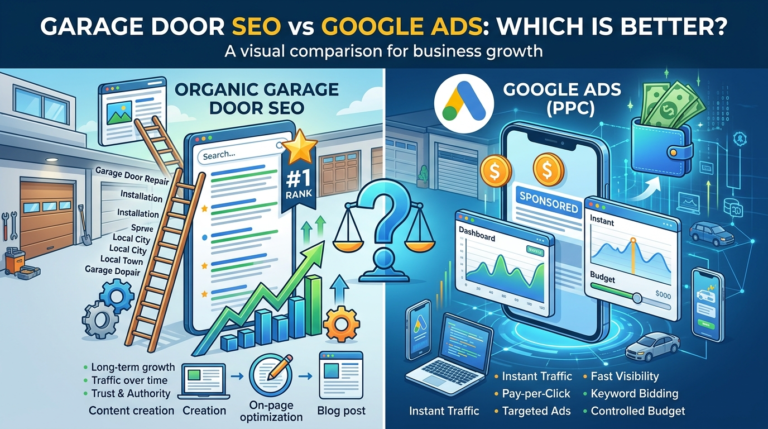
Garage Door SEO vs Google Ads: Which Is Better?
Every garage door company owner eventually asks the same question: should I put my marketing budget into SEO, into Google […]
A website can look polished and still fail at the one job it actually has, which is turning a visitor into a phone call. Plenty of tree companies have a site with…

A website can look polished and still fail at the one job it actually has, which is turning a visitor into a phone call. Plenty of tree companies have a site with nice photos and a clean layout that quietly loses leads every single day, simply because it wasn’t built with conversion in mind from the start.
This guide covers what actually separates a tree service website that sits there looking nice from one that keeps the crew booked. It includes the planning stage, structure, design choices, trust signals, technical details, and follow up systems, since a website’s job doesn’t end the moment someone submits a form.
The biggest mistake in building a tree service website happens before a single page gets designed. Jumping straight into colors and layout without first understanding who the site needs to reach and what they’re searching for tends to produce a site that looks fine but does nothing.
Before any design work begins, get clear on a few things. Who is the site actually talking to, homeowners needing routine trimming, homeowners facing an emergency after a storm, or commercial property managers, since each group responds to slightly different messaging. What do people in your area actually search for, since keyword research early on shapes not just your content but your entire page structure. And what are your competitors already doing well or poorly, since studying the top tree service sites in your market shows you both a baseline to meet and gaps you can fill that they missed.
Your domain name should be simple, memorable, and reflect your business rather than trying to stuff keywords into it. A clean business name domain tends to age better and looks more trustworthy than something crowded with search terms.
Hosting matters more than most owners realize, since a cheap, slow host undermines everything else on this list. Page speed affects both conversion and search rankings, and a huge share of mobile visitors will abandon a site that takes more than a few seconds to load. Quality, reliable hosting is one of the cheaper investments on this entire list relative to what it protects.

A visitor decides whether to stay or leave within the first few seconds of landing on your homepage, especially on mobile. That means the top of the page, what’s visible before any scrolling, needs to do a lot of work fast.
A strong homepage top section includes a clear, specific headline that states what you do and where you do it, rather than a vague tagline. A visible phone number that’s tappable on mobile, since a large share of tree service leads call directly instead of filling out a form. A prominent call to action, something like “Get a Free Quote” or “Call Now,” styled so it stands out rather than blending into the page. And a real photo, not a stock image, showing actual crew or equipment at work.
Below that top section, the rest of the homepage should briefly cover your core services, a few trust signals like reviews or certifications, and a clear path toward contacting you, without trying to cram every detail of the business into one page.
This is one of the most consistently underused strategies in the industry, and it matters for two separate reasons. It helps visitors find exactly what they came for instead of digging through a single page trying to cover everything, and it helps search engines match your site to specific searches like “stump grinding near me” rather than sending that searcher to a generic homepage that only mentions stump grinding in passing.
Each core service, tree removal, tree trimming, pruning, stump grinding, storm cleanup, and any specialty work you offer, deserves its own page with real depth. Cover what the service actually involves, when a homeowner typically needs it, how your process works, and realistic photos of that specific type of job. A thin page with two sentences does very little. A page that actually answers the questions a homeowner has before hiring does considerably more, both for conversion and for search visibility.
The same logic applies geographically. A single service area page listing town names in a sentence at the bottom of the site barely registers with either visitors or search engines. A dedicated page for each of your main service towns, written with real, specific content rather than a template with the town name swapped in, is what actually shows up when someone searches for tree work paired with their specific location.
For smaller or outlying towns where search volume is low, a shorter mention within a broader regional page is usually enough. Building a thin, near identical page for every tiny town in your radius can hurt more than it helps, since search engines tend to treat that kind of duplication unfavorably.
Tree work involves real risk. A homeowner deciding whether to let a crew take down a large tree near their house wants proof they’re hiring someone competent before they ever pick up the phone. Trust has to be visible on the page, not just assumed.
The strongest trust signals for this industry include real customer reviews displayed prominently, ideally pulled from Google since that platform tends to carry the most weight for local search credibility. Licensing, insurance, and any relevant certifications stated clearly, since these are exactly the things consumer guidance tells homeowners to look for before hiring. Real before and after photos of completed jobs, since authentic work photos consistently outperform stock imagery for building confidence. And a genuine About page introducing the people behind the business, since a company that puts a face and a story behind the work reads as more accountable than one that stays anonymous.

A large share of tree service searches happen on a phone, often during or right after a storm when someone is standing in their yard looking at storm damage. A site that wasn’t actually designed for that context, cramped text, buttons too small to tap accurately, a phone number that isn’t clickable, costs you the call to whichever competitor made that experience easier.
Every page should be tested on an actual phone, not just assumed to work because it resizes. The phone number should be a tappable link everywhere it appears. Forms should ask for the minimum information needed to follow up, since a long form on a small screen is one of the fastest ways to lose an otherwise interested visitor.
Page speed affects conversion and search rankings at the same time, which makes it one of the highest leverage technical fixes available. Tree service sites tend to be photo heavy by nature, which is good content handled badly if the images aren’t compressed properly. Large, unoptimized photos are one of the most common causes of a slow tree company website. Compressing images, choosing reliable hosting, and keeping unnecessary scripts and plugins to a minimum all contribute to keeping load times under a few seconds, which is roughly the threshold where visitor patience runs out.
Every page on the site should make the next step obvious. That means a visible phone number and a clear action button on every page, not just the homepage, since visitors can land on any page directly from a search result rather than starting at the top of the site. Vary the wording slightly by context, an emergency page might lean toward “Call Now for Immediate Help” while a routine trimming page might use “Get a Free Quote,” since matching the call to action to the visitor’s likely urgency tends to perform better than one generic phrase repeated everywhere.
Avoid burying contact information in a footer or making a visitor hunt for it. The businesses that convert best treat the phone number and the main action button as permanent fixtures on every single page.
Not every visitor wants to call immediately, so a well built form matters too. Keep it short, asking only for what you genuinely need to follow up, name, phone number, service needed, and general location is usually enough for a first contact. Every additional field is a chance for someone to abandon partway through. If photo uploads are useful for estimating storm damage or a specific job, offer that as an option rather than a requirement.
A website that generates a lead is only half the job. What happens after someone calls or submits a form determines whether that lead actually becomes a customer. Response speed has an outsized effect on this industry specifically, since a homeowner dealing with an urgent situation is often contacting more than one company at the same time and will go with whoever responds first. Aiming for a response within minutes for anything urgent, and within an hour for routine inquiries, meaningfully changes how many leads actually convert into booked jobs. This isn’t strictly a website feature, but it’s worth building the site’s forms and notifications around, since an automated confirmation message that sets expectations, and an internal alert system that gets a lead to the right person fast, both start with how the site is built.
A high converting website that nobody finds doesn’t generate leads. Building conversion focused pages and basic SEO aren’t separate projects, they should happen together from the start. That means title tags and meta descriptions written specifically for each page rather than left generic, keyword research done early enough to shape the service and location pages described earlier, HTTPS enabled site wide, and a basic technical setup that avoids broken links or slow loading elements that quietly suppress rankings over time.
A website isn’t a one time project any more than a marketing plan is. Once it’s live, tracking how visitors actually behave tells you where you’re losing people. Analytics showing which pages get traffic, how long visitors stay, and where they leave the site helps identify weak points. Call tracking tied to different pages or campaigns shows which parts of the site are actually producing leads rather than just visits. Reviewing this data periodically, rather than only when business feels slow, is what turns a website from a static brochure into something that keeps improving.
A single homepage trying to cover every service instead of dedicated service pages.
No location specific content, leaving town names buried in a footer instead of built into real pages.
Stock photography instead of real crew and job site photos.
A phone number that isn’t clickable on mobile, or buried where visitors have to search for it.
Slow load times caused by large, uncompressed images.
Long, complicated forms that ask for more than what’s needed for a first contact.
No visible trust signals, licensing, insurance, certifications, or reviews left off the page entirely.
Slow follow up after a lead comes in, letting a fast responding competitor win the job instead.
The homepage sets the first impression, but individual service pages and location pages often do more of the actual conversion and search work over time, since they match specific searches far more precisely than a generic homepage can.
A separate page for each core service performs better for both visitors and search engines. A combined page can work as a starting point for a very small business, but it limits how well you can rank for specific searches and gives visitors less confidence that you actually specialize in what they need.
Aim for under three seconds. A large share of mobile visitors abandon a site that takes longer, and load speed also factors directly into how search engines rank the page.
Avoid it if possible. Real photos, even imperfect ones, build more trust than polished stock imagery, since visitors can usually tell the difference and stock photos can read as a sign the business isn’t fully established.
As fast as realistically possible, ideally within minutes for anything urgent and within an hour for routine inquiries. Response speed has a significant, measurable effect on whether a lead actually converts into a booked job, since homeowners in urgent situations are often contacting more than one company at once.
Generally yes. A short form focused on the essentials, name, phone number, service needed, general location, converts better than a long one, since every additional field is another opportunity for someone to abandon the process partway through.
Yes, significantly. Research consistently shows that a large share of consumers judge a company’s credibility based on website design alone, and that matters even more in an industry like tree care where homeowners are trusting a crew with dangerous work near their home.
A high converting tree service website isn’t one big feature, it’s a series of smaller decisions that all point in the same direction: make it fast, make it clear, make it easy to act on, and back it up with real proof of your work. Start with a plan instead of a template, build out real service and location pages instead of one page trying to cover everything, make trust visible rather than assumed, and follow up quickly once the leads start coming in. Get those pieces right together, and the website stops being a static brochure sitting online and starts working the way your best salesperson would, day and night, whether you’re on a job site or not.
Keep reading
 Blog
Blog Every garage door company owner eventually asks the same question: should I put my marketing budget into SEO, into Google […]
 Blog
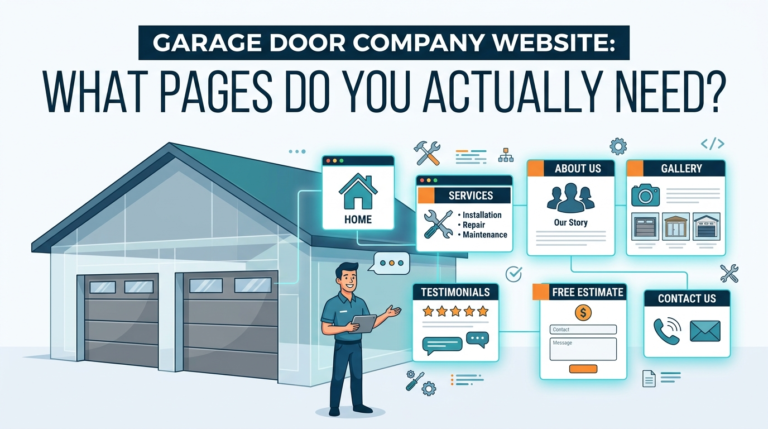
Blog A lot of garage door companies build a website with a homepage, a services page, and a contact page — […]
 Blog
Blog SEO takes months to pay off. Google Ads can start ringing your phone today. For garage door companies, where a […]
Marketing
Reviews, local SEO and a website that is easy to use work best together. Tell us about the business and we’ll tell you, plainly, what we would do next.