
Garage Door SEO vs Google Ads: Which Is Better?
Every garage door company owner eventually asks the same question: should I put my marketing budget into SEO, into Google […]
Every gym owner asks some version of the same question sooner or later: “What’s a reasonable amount to spend on Facebook and Instagram ads?” It’s a fair question, and it’s also one…

Every gym owner asks some version of the same question sooner or later: “What’s a reasonable amount to spend on Facebook and Instagram ads?” It’s a fair question, and it’s also one that rarely gets a straight answer, because most articles either throw out a single number with no context or bury you in industry jargon without ever landing on a figure you can actually use.
This article is built to fix that. Below, you’ll find realistic 2026 budget ranges for gyms of different sizes, an honest breakdown of what you’re actually paying for on Meta’s ad platform, how those costs compare to what a new member is worth, and a practical framework for deciding your own number instead of copying someone else’s.
Before getting into numbers, it’s worth understanding why gym ad budgets vary so widely, because the answer isn’t random. Your ideal spend depends on a handful of concrete factors:
With that context in mind, here’s what realistic spend actually looks like.
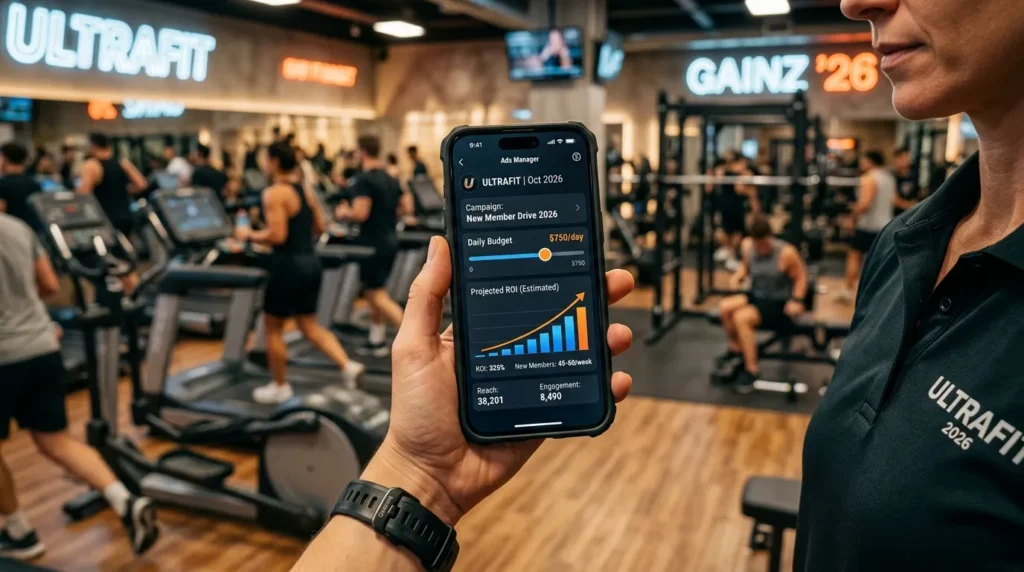
These figures reflect what’s typically needed to generate meaningful, consistent lead flow — not the bare minimum to technically have an ad running.
At this level, you’re generally running one or two active campaigns focused on lead generation or trial sign-ups, targeting a tight geographic radius around your location. Budgets below roughly $500–$1,000 a month often struggle to generate enough data for Meta’s algorithm to optimize effectively, since the system needs a consistent volume of actions (clicks, leads, or purchases) to learn who’s most likely to convert. If you’re just starting out, this range is a reasonable place to begin, with the expectation that early performance will improve as the campaign accumulates data.
At this stage, most gyms are running multiple campaigns simultaneously — one for cold prospecting to reach new audiences, one for retargeting website visitors who didn’t convert, and often a separate campaign promoting a specific offer or seasonal promotion. This budget also typically allows for creative testing, running two or three ad variations at once to see which resonates best before scaling the winner.
Larger operations usually spread budget across multiple locations, multiple audience segments (general fitness, specific class types, corporate wellness partnerships), and a fuller funnel that includes brand awareness alongside direct lead generation. At this level, it also becomes worth using Meta’s Advantage+ automated campaign tools, which have shown meaningful efficiency gains for accounts with enough budget and conversion volume to optimize against.
National or large regional brands typically run always-on brand campaigns in addition to local lead generation, often layering in Reels and Stories placements alongside traditional feed ads, and dedicating separate budget to retention and reactivation campaigns targeting past members.

Understanding the vocabulary here makes the budget numbers far easier to use in practice.
CPC (Cost Per Click) is what you pay each time someone clicks your ad. For fitness and local service businesses, CPCs generally fall somewhere in the $0.70 to $1.20 range in 2026, though this varies by targeting and creative quality.
CPM (Cost Per Thousand Impressions) is what you pay to have your ad shown 1,000 times, regardless of clicks. Health and wellness as a broader category has seen some of the steepest CPM increases across all industries recently, which makes efficient targeting and strong creative more important than ever rather than relying on cheap reach alone.
CPL (Cost Per Lead) is what you pay for each person who submits their contact information, typically through a trial offer or consultation request. This is the number most gym owners should actually be watching day to day, since it connects ad spend directly to your sales funnel. Fitness and training centers have generally trended toward the more affordable end of the cost-per-lead spectrum compared to the broader business average, though this figure has shown considerable month-to-month volatility, so it’s worth tracking your own trend over a period of months rather than reacting to any single week.
CPA (Cost Per Acquisition) is what you pay for an actual paying member, factoring in your close rate from lead to sale. This is the number that ultimately tells you whether your ad spend is profitable.
ROAS (Return on Ad Spend) measures revenue generated for every dollar spent on ads. For a gym, this should be calculated using a member’s lifetime value, not just their first month’s payment, since membership businesses earn most of their real return over many months of retained membership.
Rather than picking a budget number first and hoping it works, the more reliable approach is working backward from what a new member is actually worth to your business.
Here’s a simple way to think through it:
This kind of calculation is far more useful than any generic “spend $X per month” recommendation, because it’s based on your actual numbers rather than an industry average that may not reflect your specific membership price, retention rate, or local market.

Underfunding the learning phase. Meta’s delivery algorithm needs a certain volume of conversion events to optimize effectively. Setting a budget so low that a campaign barely generates any leads at all means the algorithm never gets the data it needs to improve, and the campaign underperforms indefinitely as a result.
Ignoring seasonality entirely. Spending the exact same amount every month regardless of season leaves opportunity on the table. Many gyms see their best return by front-loading spend into the January resolution season and back-loading creative testing into the historically cheaper first quarter, then adjusting budget upward heading into the busier back-to-school and pre-summer periods.
Judging performance too early. A campaign that’s only been running for three or four days hasn’t given Meta’s algorithm enough time to optimize, and judging results at that point often leads to premature, unnecessary changes that reset the learning process and waste the budget already spent.
Focusing on CPC or CPM instead of CPA. A cheap cost per click means very little if those clicks rarely convert into members. Always evaluate performance based on what a paying member actually costs you, not on how inexpensive the traffic looks on the surface.
Splitting budget across too many campaigns at once. Spreading $1,000 across six different campaigns often means none of them get enough volume individually to perform well. It’s generally more effective to concentrate budget into fewer, well-targeted campaigns until you have enough total spend to support meaningful diversification.
If you’re not sure where to begin, here’s a straightforward way to set your first budget:
There’s no universal dollar figure that’s right for every gym, and any article that gives you one flat number without asking about your membership price, your location, or your conversion funnel is oversimplifying a genuinely nuanced decision. What does hold true across the board is this, budgets under roughly $500 a month rarely generate enough data to perform well, mid-size gyms typically find their sweet spot somewhere between $1,500 and $4,000 a month once campaigns are dialed in, and the smartest way to land on your own number is working backward from what a member is actually worth to your business rather than guessing forward from an arbitrary starting budget. You can contact to professional Digital Marketing Agency as well, for better learning, and services.
Keep reading
 Blog
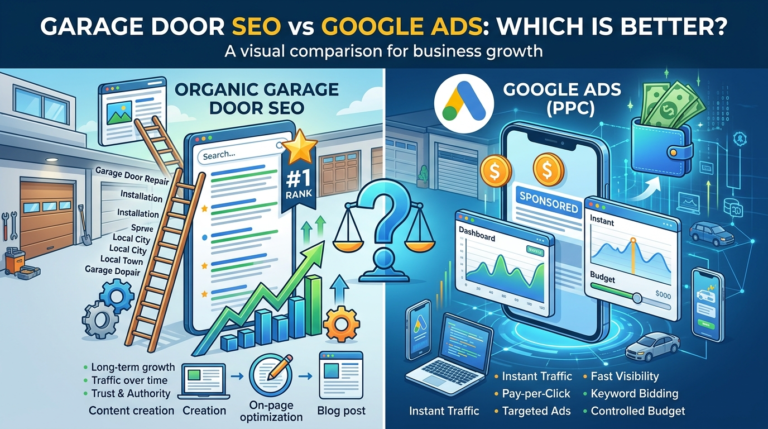
Blog Every garage door company owner eventually asks the same question: should I put my marketing budget into SEO, into Google […]
 Blog
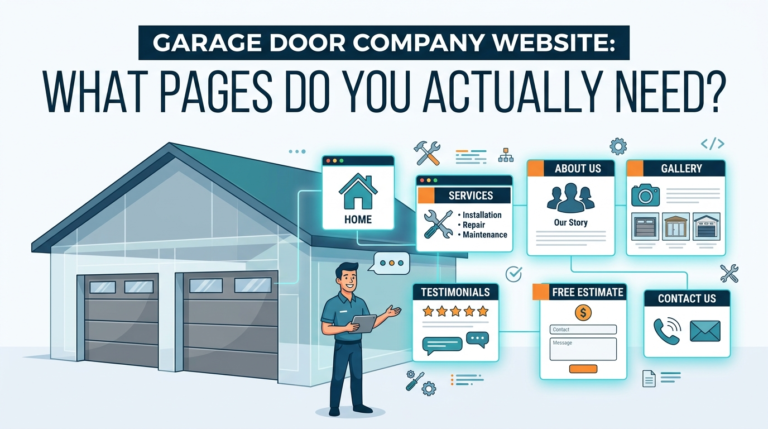
Blog A lot of garage door companies build a website with a homepage, a services page, and a contact page — […]
 Blog
Blog SEO takes months to pay off. Google Ads can start ringing your phone today. For garage door companies, where a […]
Marketing
Reviews, local SEO and a website that is easy to use work best together. Tell us about the business and we’ll tell you, plainly, what we would do next.