
Garage Door SEO vs Google Ads: Which Is Better?
Every garage door company owner eventually asks the same question: should I put my marketing budget into SEO, into Google […]
If you own or manage a gym, “gym near me” is probably the single most valuable search phrase in your entire marketing world. It’s typed by people who are ready to join…
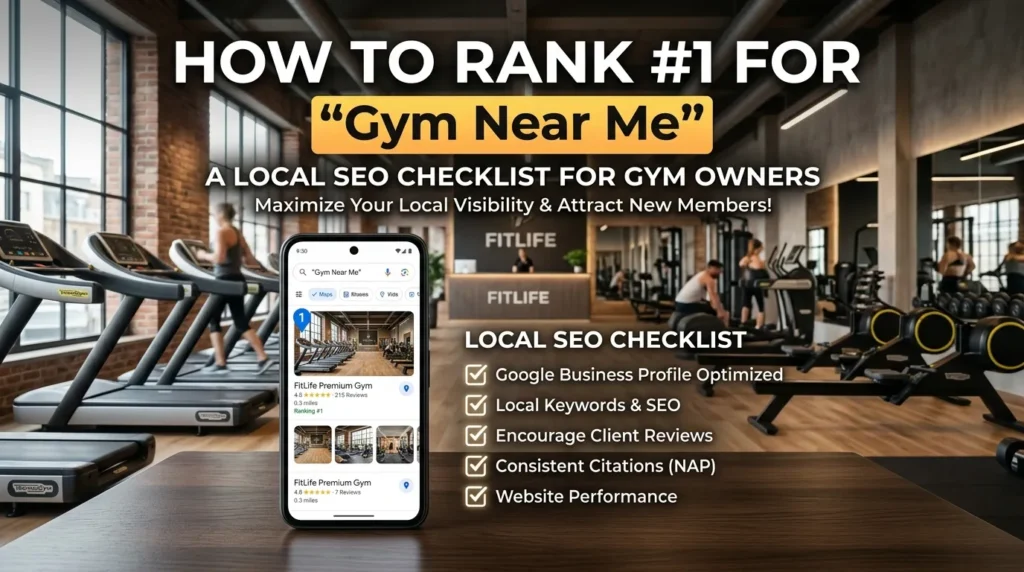
If you own or manage a gym, “gym near me” is probably the single most valuable search phrase in your entire marketing world. It’s typed by people who are ready to join — not people who are browsing workout tips at 11 p.m. They want a gym, they want it close by, and they want it now.
The problem is that almost every gym owner in your city is chasing the exact same three spots on Google — the “map pack” — and most of them are doing it the wrong way. They throw money at Instagram ads, ignore their Google Business Profile for months at a time, and wonder why a smaller gym two blocks away keeps showing up above them.
This checklist breaks down exactly what actually moves the needle in 2026, based on how Google’s local algorithm currently weighs ranking signals, and in what order you should tackle it. No fluff, no outdated tricks — just a step-by-step system you can start using today.
Before jumping into the checklist, it helps to understand the three pillars Google uses to rank every local business:
You can’t change how close you are to someone’s house. But relevance and prominence are almost entirely in your hands, and together they make up the majority of what you can actually control. Recent industry surveys of local SEO specialists put Google Business Profile signals, review activity, and on-page website optimization as the three biggest levers a business owner can pull. That’s exactly where this checklist is going to focus your energy.
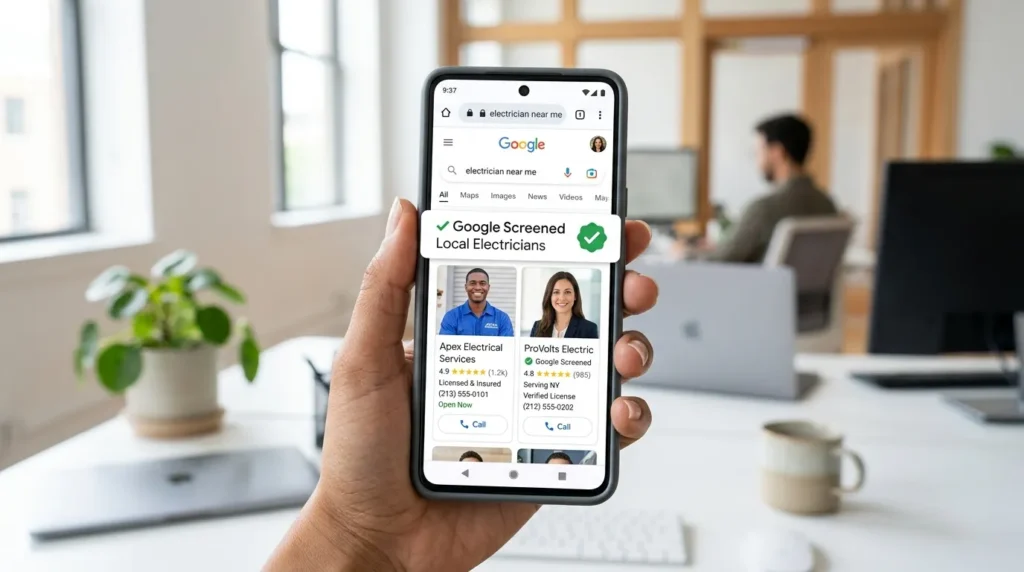
Your Google Business Profile (GBP) is the single most powerful free asset your gym owns. Treat it like a living storefront, not a listing you set up once and forget.
If you haven’t verified ownership of your GBP listing yet, this is step zero. An unverified or unclaimed profile can’t be optimized and won’t be trusted by Google.
Use your real, legal gym name — nothing more. Do not stuff keywords like “Best Gym in [City] | 24/7 Fitness Center” into the name field. This violates Google’s guidelines and can get your listing suspended, which will tank your visibility overnight.
Your primary category is one of the strongest ranking signals available to you. “Gym” is often too broad — depending on what you actually offer, consider more specific options like “Fitness Center,” “CrossFit Box,” “Personal Trainer,” “Yoga Studio,” or “Boxing Gym.” Pick the category that most precisely matches your core service, then add secondary categories to cover everything else you offer (personal training, group classes, nutrition coaching, etc.).
Hours, phone number, website, service area, opening date, attributes (wheelchair accessible, free Wi-Fi, on-site parking, women-only hours if applicable) — all of it. A half-completed profile sends a weak signal. A fully completed one tells Google you’re a real, active, trustworthy business worth showing to searchers.
Google has confirmed the description field doesn’t directly influence rankings, so stop keyword-stuffing it. Use it to clearly explain what makes your gym different — your equipment, your coaching philosophy, your community — in plain language a potential member would actually want to read.
Real photos of your space, equipment, classes, trainers, and members (with permission) build trust and engagement. Profiles that add new photos every couple of weeks consistently outperform ones that upload once a quarter. Skip the temptation to “geotag” photos for SEO purposes — that tactic has been tested and debunked; it does nothing for rankings and Google strips that data anyway.
Announce new classes, promotions, events, or milestones through Google Posts. These don’t directly move your ranking position, but they boost click-through rates and engagement, which feed into the behavioral signals Google does track.
Many gym shoppers will message before they call. A slow or missing response loses the lead entirely, regardless of how well you rank.
If you offer 24-hour access, list it. Google tends to deprioritize businesses that appear closed, and after-hours searches are often far less competitive — an easy win many gyms leave on the table.

Reviews now carry serious weight in local rankings, and that weight keeps climbing every year. Nearly 9 out of 10 consumers read reviews before choosing a local business, and gyms with a thin review count or a rating under 4 stars see a real drop-off in trust and conversions.
Don’t leave reviews to chance. Train front-desk staff and trainers to ask happy members for a review at natural high-satisfaction moments — right after a great class, a PR, or a body-transformation milestone.
A steady trickle of new reviews every week outperforms a single push of fifty reviews followed by silence. Google reads consistent activity as an ongoing sign of trust, while a sudden spike followed by nothing can look artificial.
There’s a noticeable visibility jump once a profile crosses roughly ten reviews. If your gym is sitting below that number, this should be priority one this month.
Businesses that reply to a high share of their reviews see a measurable ranking and trust boost. A thoughtful reply to a negative review, handled calmly and professionally, often builds more credibility with future members than the negative review itself takes away.
When a reviewer writes something like “the small-group HIIT classes here are incredible” or “my trainer helped me finally fix my squat form,” it creates what’s sometimes called a review justification — text that directly ties your business to the exact services people are searching for. A simple prompt when asking for a review (“mention what class or trainer helped you most!”) goes a long way.
Google, Facebook, and Yelp reviews all contribute to your overall online reputation and prominence. Don’t put all your eggs in one basket.
Your website anchors your Google Business Profile and gives Google (and searchers) the deeper detail your GBP can’t hold.
If your gym has one location, your homepage should clearly and prominently include your city and neighborhood name, service area, and NAP (Name, Address, Phone number) information. If you operate multiple locations, build a separate, unique page for each one — never just swap the city name across identical template pages, as thin duplicate content undermines your relevance.
Your business name, address, and phone number must be identical across your website, Google Business Profile, and every directory listing. Even small inconsistencies (Street vs. St., a missing suite number) can quietly erode trust signals.
Phrases like “gym in [neighborhood]” or “[city] personal training” should appear in your page title, H1, and a few times in the body copy — written the way a real person would say it, not stuffed in awkwardly.
Structured data (schema) helps search engines and AI systems clearly understand your business name, address, hours, services, and reviews. This has become one of the most impactful on-page factors for local rankings and is increasingly important for showing up correctly in AI-generated search summaries.
Most “gym near me” searches happen on a phone, often while someone is standing outside deciding whether to walk in. A slow-loading or clunky mobile site loses that decision moment, so its better to make site fast and mobile friendly.
Include questions like “Is there a gym near me open 24 hours?” or “Does this gym offer a free trial?” This captures long-tail local search traffic and gives Google more relevant content to match against real queries.
Blog posts tied to your actual neighborhood — a roundup of the best post-workout meal spots nearby, a guide to local running routes, coverage of a community event you sponsored — reinforce your local relevance far more than generic fitness content ever will.
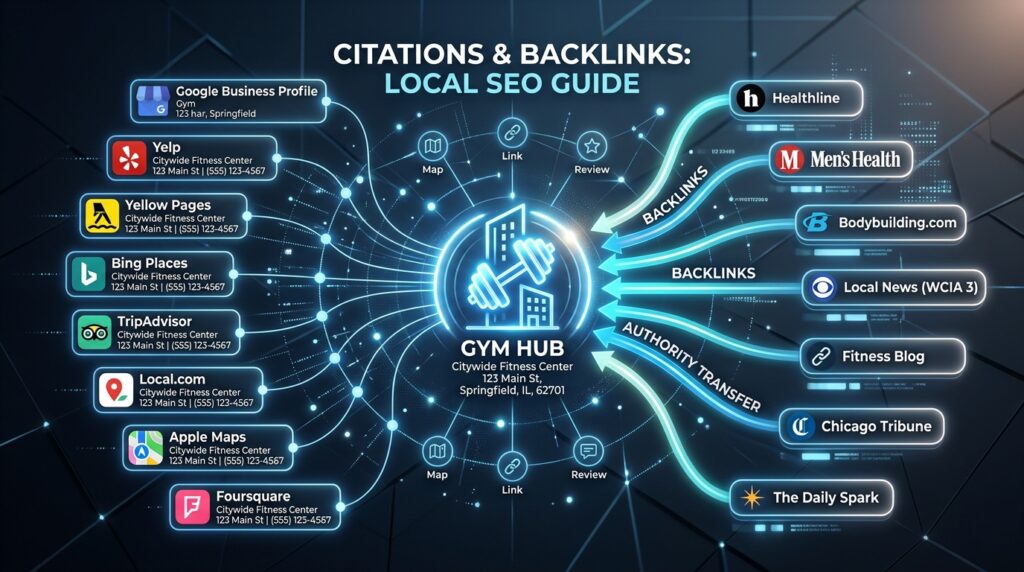
List your gym consistently across major directories (Yelp, Apple Maps, Bing Places, local chamber of commerce sites, industry-specific fitness directories). While citation building carries less relative weight than it used to, inconsistent or missing citations still quietly hurt your prominence score.
A meaningful share of searches, especially on iPhones, now happen outside Google entirely. Keeping these listings current also feeds AI-driven answer engines that increasingly pull business data from multiple sources.
A single mention from a local news outlet, a community sports league, a school partnership, or a well-known local blog carries far more weight than dozens of generic directory links. Sponsor a 5K, host a charity workout event, or partner with a local business — these create natural, relevant backlinks along with real community goodwill.
These links signal legitimacy and community roots directly to Google’s understanding of your business.
The number of people who click through to your website, request directions, or call directly from your listing all feed into behavioral ranking signals. A strong, benefit-driven business description and clear photos improve this naturally.
Use the same business name, service descriptions, and terminology everywhere — your website, GBP, social profiles, and directories. AI-driven search tools and answer engines increasingly rely on this consistency to confidently recommend your gym.
Search behavior is shifting toward AI assistants and AI-generated overviews. Periodically check how your gym is described (or whether it appears at all) in tools like ChatGPT or Google’s AI Overviews, and make sure your website content answers common questions clearly and factually.
If this list feels like a lot, here’s how to prioritize it:
Week 1: Fully complete your Google Business Profile, fix your primary category, and correct any NAP inconsistencies.
Week 2: Launch a systematic review-request process with front-desk and trainer staff.
Week 3: Build or improve your website’s location page and add schema markup.
Week 4: Start local link-building outreach (sponsorships, community partnerships, local press) and set a recurring habit of posting fresh photos and Google Posts.
Ranking #1 for “gym near me” isn’t about finding some hidden trick — it’s about consistently doing the fundamentals better than the gym down the street. A complete, active Google Business Profile, a steady stream of genuine reviews, a fast and locally-optimized website, and real community connections will outperform any shortcut over time.
Local search rewards businesses that look real, active, and trusted — because that’s exactly what a potential member is looking for when they type “gym near me” and choose where to spend their money and their time.
Keep reading
 Blog
Blog Every garage door company owner eventually asks the same question: should I put my marketing budget into SEO, into Google […]
 Blog
Blog A lot of garage door companies build a website with a homepage, a services page, and a contact page — […]
 Blog
Blog SEO takes months to pay off. Google Ads can start ringing your phone today. For garage door companies, where a […]
Marketing
Reviews, local SEO and a website that is easy to use work best together. Tell us about the business and we’ll tell you, plainly, what we would do next.