
Garage Door SEO vs Google Ads: Which Is Better?
Every garage door company owner eventually asks the same question: should I put my marketing budget into SEO, into Google […]
Chiropractor near me” is one of those searches that tells you everything about the person typing it. They’re not browsing. They’re not comparing prices for fun. Someone with a stiff neck or…
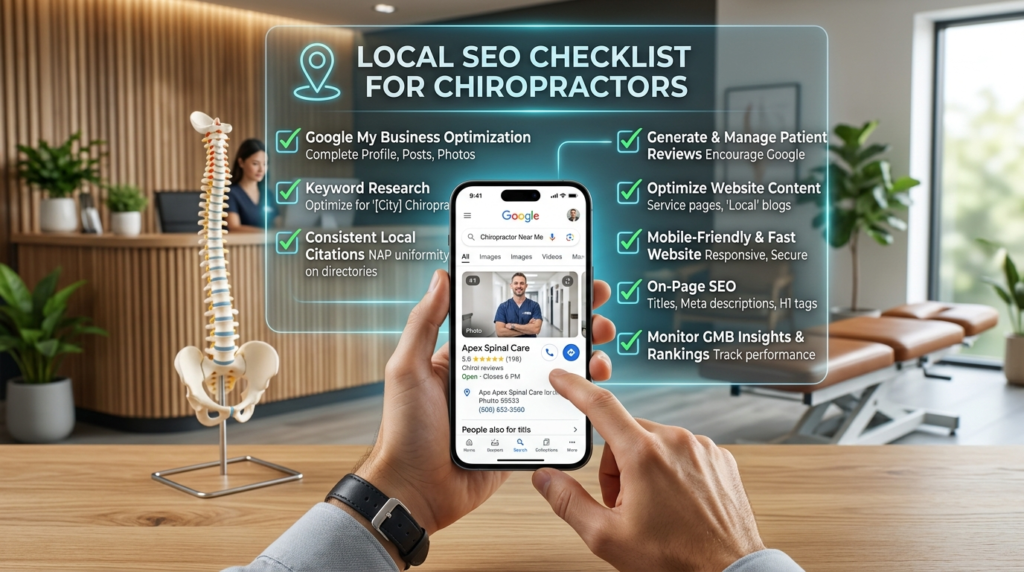
Chiropractor near me” is one of those searches that tells you everything about the person typing it. They’re not browsing. They’re not comparing prices for fun. Someone with a stiff neck or a bad back is sitting there, phone in hand, ready to call whoever shows up first. If your clinic isn’t one of the first results, that patient is calling someone else, and they’re calling them today.
The good news is that ranking for searches like this isn’t about some secret trick. It’s about doing a specific set of things consistently, the same way every successful local business does. Below is a practical checklist you can actually work through, not a list of vague advice.
This is the foundation everything else builds on. If you haven’t claimed your listing yet, that’s step one. If you have, go back through it and make sure nothing is left blank, business hours, phone number, website link, appointment booking link, business category, attributes (wheelchair accessible, accepts new patients, and so on). An incomplete profile is a missed opportunity sitting in plain sight.
Your primary category should be “Chiropractor,” not something broader like “Medical Clinic” or “Health Consultant.” Google relies heavily on this single field to decide which searches your listing should appear in. If you offer additional services like massage therapy or physical rehab, add those as secondary categories instead of changing your primary one.
Your business name, address, and phone number need to appear exactly the same way on your website, your Google profile, Yelp, Healthgrades, Facebook, and any directory you’re listed on. Even small differences, like “St.” versus “Street” or a missing suite number, can quietly hurt your local rankings. Go through your major listings one by one and fix anything that doesn’t match.
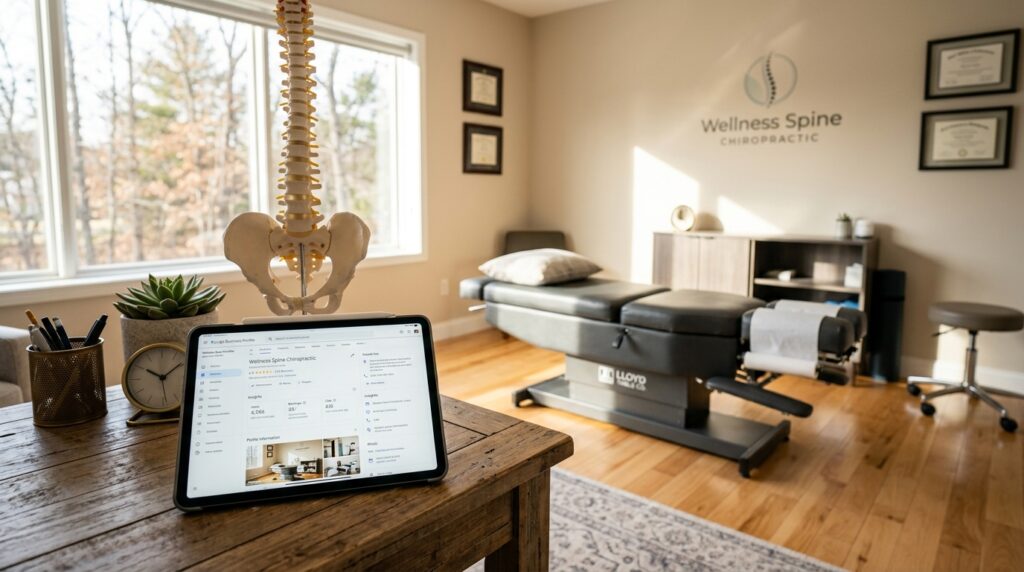
If your clinic serves more than one city or neighborhood, create separate pages for each area rather than one generic “service area” page. A page built around “Chiropractic Care in [Neighborhood Name]” that genuinely talks about that area, the kinds of patients you see there, and how to find your clinic from that part of town will outperform a single page trying to cover everywhere at once.
Even single-location practices benefit from naturally working their city and neighborhood name into their homepage, service pages, and blog content, not stuffed in awkwardly, just written the way you’d actually describe your practice to someone.
Beyond Google, patients (and search engines) check directories like Yelp, Healthgrades, Bing Places, Apple Maps, and chiropractic-specific directories. Each accurate listing acts as another signal confirming your clinic is a real, established business at a real location. Set aside an afternoon to claim and complete your profile on the major ones, then revisit every few months to keep them current.
Links from other local websites pointing to yours tell Google your clinic is genuinely part of the community, not just a name on a map. A few realistic ways to build these:
These links don’t need to come from huge websites. A handful of genuine, local connections will do more for your rankings than a pile of generic, unrelated links ever will.
Review quantity matters, but consistency matters just as much. A clinic with 80 reviews from three years ago looks far less active to Google (and to patients) than a clinic with 40 reviews, several of which came in this month. Build a simple habit of asking satisfied patients for a review right after a good visit, whether that’s a quick text with a direct link or a printed card at checkout.
Respond to every review you get. It shows future patients that someone is actually paying attention, and it’s a small trust signal that adds up.
Most “chiropractor near me” searches happen on a phone, often while someone is in pain and wants quick answers. If your website is slow to load or hard to navigate on mobile, you’ll lose people before they ever reach your contact form. Check your site on your own phone regularly: Is your phone number clickable? Can someone book an appointment in under a minute? Does the page load in a couple of seconds?
Schema markup is a bit of code added to your website that helps search engines understand exactly what your business is, where it’s located, and what services you offer. It won’t change what visitors see on the page, but it gives Google clearer signals to work with. If this sounds too technical to handle yourself, most web developers or SEO specialists can add it in under an hour.
A blog that answers real questions your patients ask, “Can a chiropractor help with sciatica?”, “What should I expect at my first chiropractic appointment?”, “Is chiropractic care safe during pregnancy?, does double duty. It builds trust with people researching their options, and it gives Google fresh, relevant content to associate with your site. Weave in your city or neighborhood naturally where it fits, rather than forcing it into every sentence.
Search “chiropractor near me” and your city name from a few different devices and locations, or use a rank-tracking tool, to see where you currently land in the map results. This gives you a baseline. Check again every month or two. If you slip, look at what recently changed a competitor adding new reviews, a directory listing going inconsistent, or your own profile going stale are usually the culprits.
Local SEO isn’t something that delivers results in a week. Most of these steps compound over a few months of steady effort. The clinics that consistently rank well aren’t the ones that did a big push once and stopped, they’re the ones that kept their information accurate, kept collecting reviews, and kept publishing useful content month after month.
None of the items on this checklist are complicated on their own. What separates clinics that rank well from clinics that don’t usually isn’t knowledge, it’s follow-through. Pick a few items from this list you haven’t done yet, work through them this month, and treat the rest as an ongoing part of running your practice rather than a one-time project. Over time, that consistency is exactly what gets a chiropractic clinic to the top of the map when someone nearby searches for help.
Keep reading
 Blog
Blog Every garage door company owner eventually asks the same question: should I put my marketing budget into SEO, into Google […]
 Blog
Blog A lot of garage door companies build a website with a homepage, a services page, and a contact page — […]
 Blog
Blog SEO takes months to pay off. Google Ads can start ringing your phone today. For garage door companies, where a […]
Marketing
Reviews, local SEO and a website that is easy to use work best together. Tell us about the business and we’ll tell you, plainly, what we would do next.