
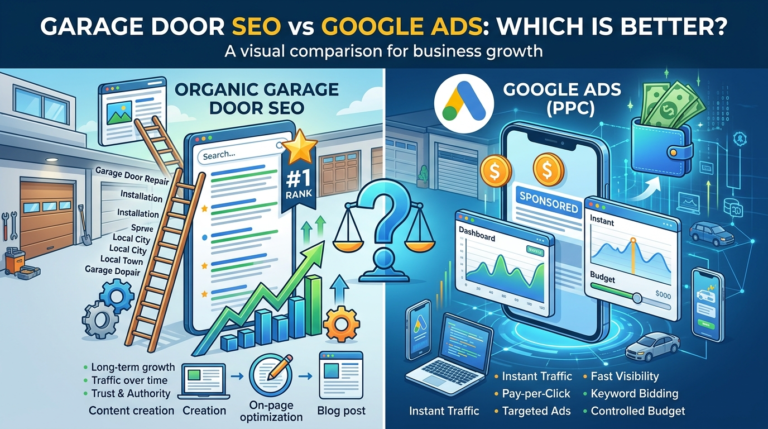
Garage Door SEO vs Google Ads: Which Is Better?
Every garage door company owner eventually asks the same question: should I put my marketing budget into SEO, into Google […]
Ask most chiropractors why reviews matter and they’ll say something about reputation, about patients trusting a clinic with more stars. That’s true, but it’s only half the Ask most chiropractors why reviews…

Ask most chiropractors why reviews matter and they’ll say something about reputation, about patients trusting a clinic with more stars. That’s true, but it’s only half the Ask most chiropractors why reviews matter and they’ll say something about reputation, about patients trusting a clinic with more stars. That’s true, but it’s only half the picture. Reviews don’t just influence whether someone decides to call you. They directly influence whether your clinic shows up in front of that person in the first place. Google treats reviews as one of the clearest signals it has for deciding which local businesses deserve to be shown first, and for a chiropractic clinic competing in a crowded local market, that’s not a small detail.
Here’s what’s actually happening behind the scenes, and what it means for how you should be thinking about reviews.
Google’s local ranking system relies heavily on something often summarized as relevance, distance, and prominence. Reviews sit squarely inside that third factor. A clinic with a healthy number of positive, recent reviews signals to Google that real people are visiting, having good experiences, and vouching for the business. A clinic with few reviews, or reviews that stopped coming in years ago, gives Google far less confidence to recommend it.
This means two clinics with nearly identical websites and services can end up in very different positions on the map simply because one has built a stronger, more active review profile than the other.
A lot of chiropractors assume the goal is simply to hit five stars and stop worrying about it. In reality, several different elements of your reviews matter, not just the average rating:
Review quantity — More reviews generally signal a more established, trusted business, as long as they’re genuine.
Review recency — A steady stream of new reviews carries more weight than a large pile of old ones. A clinic with 60 reviews from three years ago looks less active than a clinic with 25 reviews, several of which came in the last month.
Review content — Google’s systems can pick up on keywords within reviews. A review that mentions “great chiropractor for back pain in [city]” naturally reinforces relevant local search terms in a way that feels organic, because it is organic.
Response rate — Clinics that respond to reviews, both positive and negative, tend to come across as more engaged and trustworthy, both to patients reading them and to the ranking systems evaluating overall activity.
Plenty of clinic owners get anxious the moment a negative review shows up, sometimes to the point of ignoring their review profile altogether out of worry. In practice, an occasional negative review, especially one you’ve responded to thoughtfully, often does more to build credibility than a suspiciously perfect five-star record. Patients tend to trust a profile that looks human. A calm, professional response to a complaint shows future patients exactly how you’d handle any concerns they might have too.
What actually hurts a clinic isn’t a single bad review. It’s a pattern of unaddressed complaints, or worse, no reviews at all, which leaves potential patients with nothing to base their decision on except guesswork.
There’s a second layer to this that’s easy to miss. Even if two clinics rank next to each other in the local pack, the one with stronger reviews is far more likely to get clicked. Someone scanning search results skims star ratings almost instinctively before reading anything else. A clinic sitting at 4.9 stars with 80 reviews is going to pull far more clicks than one sitting at 3.8 stars with 12 reviews, even if they’re both technically visible.
Search engines pay attention to this kind of engagement over time. A listing that consistently earns more clicks and calls sends a positive signal back into the system, which can reinforce and even improve its position further. In other words, strong reviews don’t just help you get seen. They help you stay seen.

The clinics that do well here rarely have some clever trick. They simply built a repeatable habit into their patient process. A few approaches that work without feeling forced:
The goal isn’t to chase a number. It’s to make leaving a review a normal, low-friction part of finishing a visit, so it happens consistently rather than in occasional bursts.
Every review, positive or negative, is worth a response. A quick, genuine thank-you on a positive review reinforces goodwill and shows you’re paying attention. A calm, solution-focused response to a negative review can turn a moment of frustration into a demonstration of how seriously you take patient care.
Avoid generic, copy-pasted responses. A reply like “Thank you for your feedback” on every single review reads as hollow. Take the extra thirty seconds to reference something specific from what the patient wrote. It costs almost nothing and it makes a noticeable difference in how the response comes across to anyone else reading it later.
If your review profile has gone quiet, that’s usually not a sign your patients are unhappy. It’s simply a sign that asking for reviews hasn’t become part of your regular process yet. That’s an easy thing to fix, and often one of the highest-return changes a clinic can make, since it touches both how many patients find you and how many of them choose to call once they do.
Treat your reviews the same way you’d treat any other ongoing part of running your practice: something that needs steady attention, not a task you handle once and forget about. A consistent flow of honest, recent reviews tells Google your clinic is active and trusted, and it tells potential patients the exact same thing, often in the same glance.
Keep reading
 Blog
Blog Every garage door company owner eventually asks the same question: should I put my marketing budget into SEO, into Google […]
 Blog
Blog A lot of garage door companies build a website with a homepage, a services page, and a contact page — […]
 Blog
Blog SEO takes months to pay off. Google Ads can start ringing your phone today. For garage door companies, where a […]
Marketing
Reviews, local SEO and a website that is easy to use work best together. Tell us about the business and we’ll tell you, plainly, what we would do next.